Summary
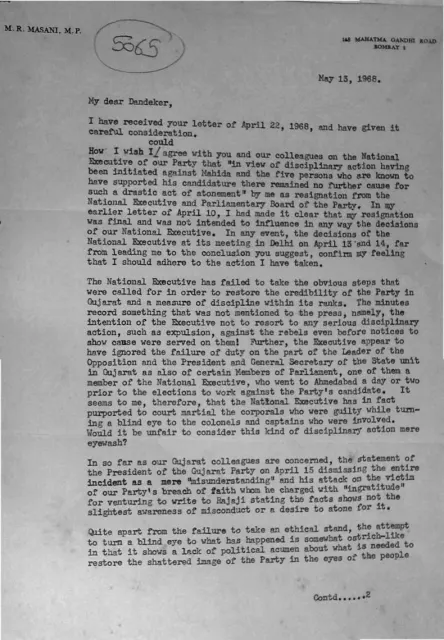
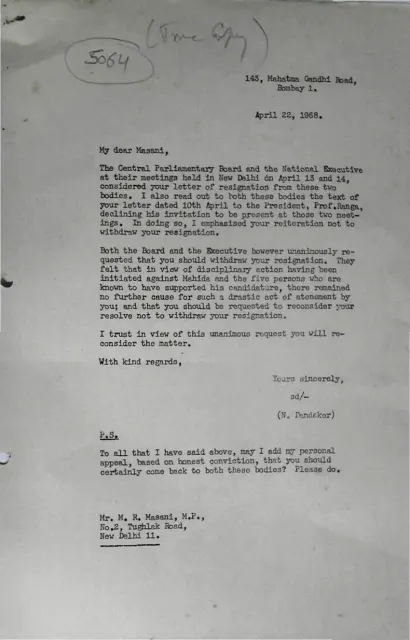
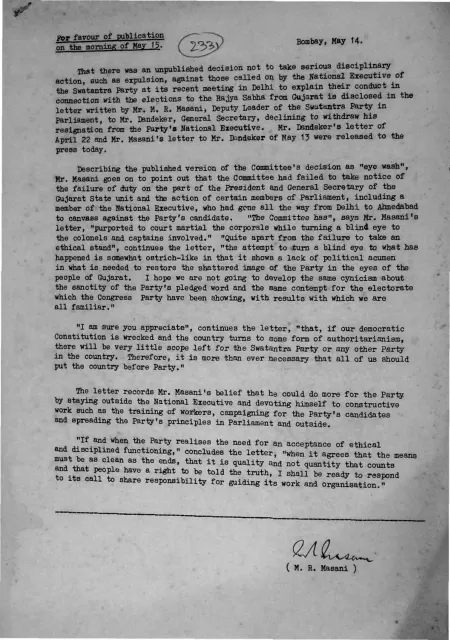
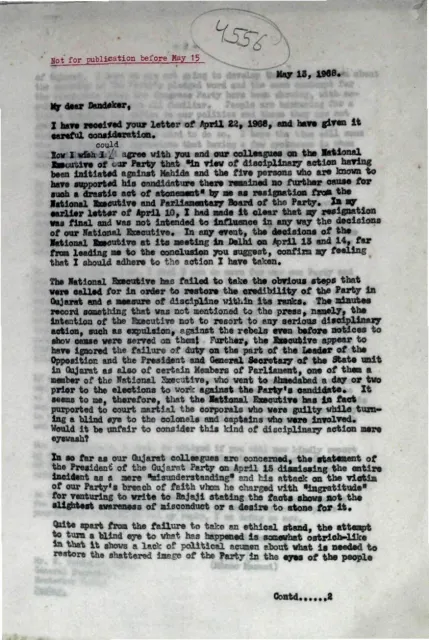
In this letter dated May 15, 1968, Minoo Masani rejects a proposal that he withdraw his resignation from the Swatantra Party’s National Executive and Parliamentary Board. He argues that the party failed to respond credibly to disciplinary issues involving its Gujarat organisation, including its treatment of Mehdi and five others, and that it applied disciplinary standards inconsistently by acting against alleged rebels while overlooking election-related misconduct by senior party figures. Masani describes the party’s public response as an attempt to minimise the incident rather than confront it ethically.
Masani broadens the dispute into a defence of democratic political practice. He warns that declining public faith in political parties and parliamentary democracy could leave India vulnerable to authoritarianism, and insists that the country must take precedence over any party. He therefore proposes to continue working outside the party’s formal leadership, including training young workers and expressing the suppressed views of dissatisfied party members. He says he would return to active responsibility if the party adopts ethical, disciplined functioning and tells the truth. The document concludes with a request that his resignation be reported to the party’s General Council before its June meeting, and authorises publication of his April 22 letter and this reply.
Key points
- Masani confirms that his resignation from the Swatantra Party’s National Executive and Parliamentary Board is final.
- He criticises the party’s handling of disciplinary action against Mehdi and five other people.
- He argues that the party applied discipline selectively, punishing alleged rebels while overlooking election-related misconduct by senior Gujarat leaders.
- He rejects the Gujarat Party president’s dismissal of the incident as a misunderstanding and condemns the effort to minimise it publicly.
- He links the party dispute to declining faith in political parties, parliamentary democracy, and the democratic process.
- He proposes constructive work outside the party leadership, including training programmes for young workers and advocacy for the party’s principles.
- He remains willing to resume responsibility if the party adopts ethical, disciplined functioning and truthful political communication.
Metadata and summary are AI-extracted from the source PDF and reviewed for editorial accuracy. The original work is available via the Read PDF tab above (where present); paragraph-level citation inside the PDF is deferred to a future engagement.