letter
Letter to N Dandeker
Swatantra Party · MADRAS-17 · 1968
3 pages
Summary
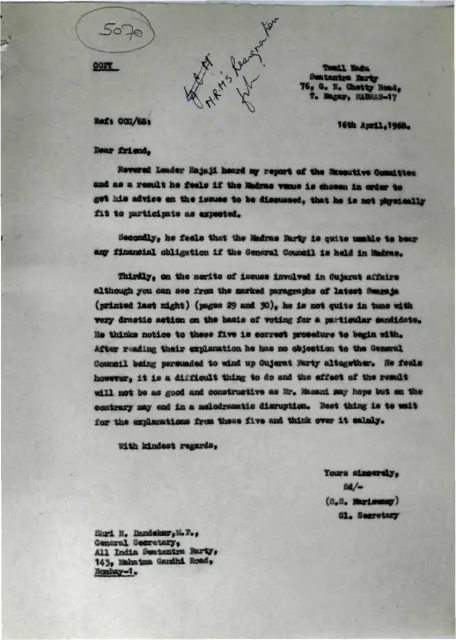
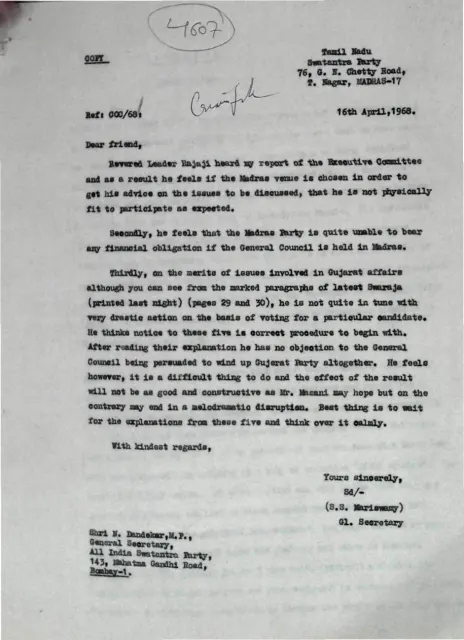
This 16 April 1968 Swatantra Party office letter from General Secretary S. S. Mariwalla to N. Dandekar reports C. Rajagopalachari’s objections to holding the party’s General Council in Madras. Rajaji is described as physically unable to participate if the venue is selected for his advice, while the Madras Party is said to be unable to bear the associated financial obligation. The letter also discusses disputes over Gujarat affairs: Rajaji reportedly questions the procedure behind proposed action based on voting for a particular candidate, and urges that the explanations of five people be considered calmly before deciding whether to wind up the Gujarat Party.
The attached Swarajya text argues that Swatantra Party discipline must not become unquestioning obedience or suppress individual opinion. It defends free speech within the party, distinguishes the difficult work of educating people from the easier work of spreading anger and falsehood, and calls for politically capable “field educators” rather than workers who merely cultivate hostility. Its stated political ideal is education of the public, including economic education and goodwill toward all religions and communities, rather than the creation of blind attachments.
Key points
- Rajaji is reported to be physically unable to attend a Madras General Council meeting convened partly to obtain his advice.
- The letter says the Madras Party cannot meet the financial obligations of hosting the General Council.
- Rajaji questions the procedure followed in Gujarat affairs and recommends waiting for explanations from five individuals.
- The attached Swarajya text rejects party discipline understood as total subordination and extinction of individual freedom of opinion.
- The text defends free speech and internal opinion as compatible with party coherence.
- It contrasts the easy spread of anger, jealousy, falsehood, and communal or class antagonism with the slow work of establishing truth.
- It calls for field educators with economic and political competence and defines politics as educating the people.
Metadata and summary are AI-extracted from the source PDF and reviewed for editorial accuracy. The original work is available via the Read PDF tab above (where present); paragraph-level citation inside the PDF is deferred to a future engagement.