Summary
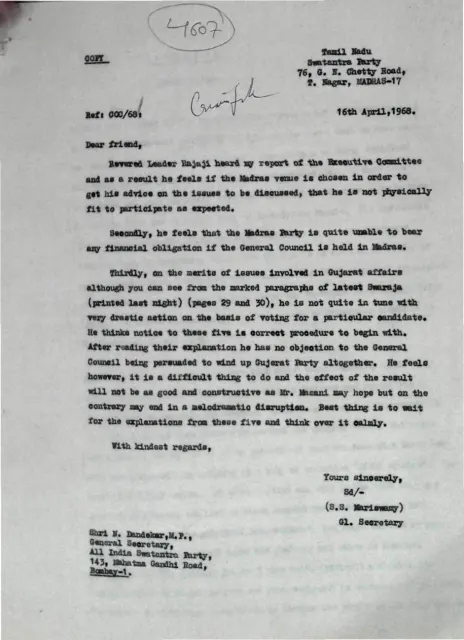
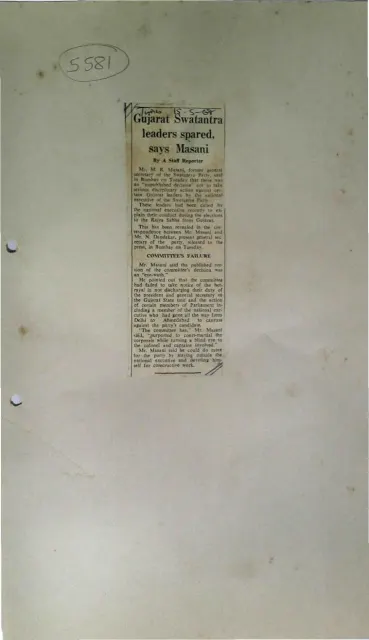
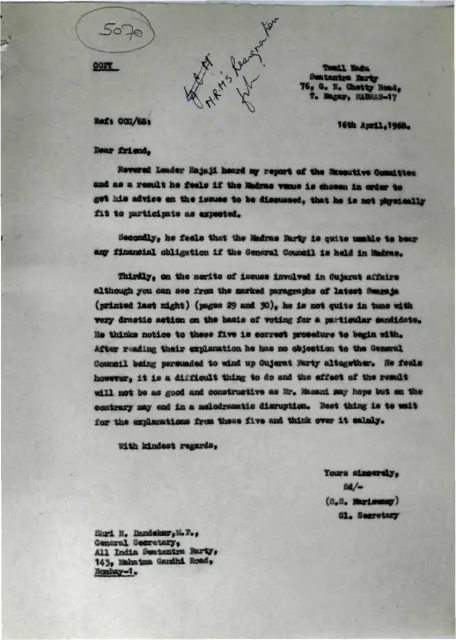
This three-page English-language document consists of a letter from M. R. Masani, General Secretary of the Swatantra Party, to N. Dandekar dated 16 April 1968, followed by a reproduced Swarajya text dated 20 April 1968. In the letter, Masani reports that Rajaji considers himself physically unfit to participate as expected, that the Madras Party cannot bear the financial obligations of holding a General Council in Madras, and that the party should await explanations concerning the Gujarat affairs before taking a drastic decision. Masani warns that prematurely winding up the Gujarat Party could produce a “melodramatic disruption” rather than a constructive outcome.
The attached Swarajya text defends internal dissent and free discussion within the Swatantra Party. It criticises the suppression of opinions and coercive discipline, arguing that the party should preserve an “independent” spirit while remaining faithful to its fundamental principles. The text also contrasts the easy spread of jealousy, anger, and falsehood with the harder work of restraint, education, and truth-telling. It calls for better-calibre field workers and presents politics as the education of citizens rather than the creation of blind attachments. The text closes by invoking Gandhi’s emphasis on widespread economic education and broad-mindedness toward all religions and communities.
Key points
- Masani’s letter records Rajaji’s physical unfitness and the Madras Party’s inability to finance a General Council in Madras.
- The letter urges caution over proposed action concerning the Gujarat Party and recommends waiting for explanations before deciding.
- The reproduced Swarajya text rejects party discipline when it suppresses independent opinion and corrective criticism.
- It argues that Swatantra should not become a blind or mechanically obedient political organisation.
- The text distinguishes destructive mobilisation of anger and jealousy from the difficult work of educating citizens and disseminating truth.
- It calls for effective, capable field workers and identifies economic education and religious broad-mindedness as essential political work.
Metadata and summary are AI-extracted from the source PDF and reviewed for editorial accuracy. The original work is available via the Read PDF tab above (where present); paragraph-level citation inside the PDF is deferred to a future engagement.