letter
Letter to C Rajagopalachari
New Delhi · 1963
2 pages
Summary
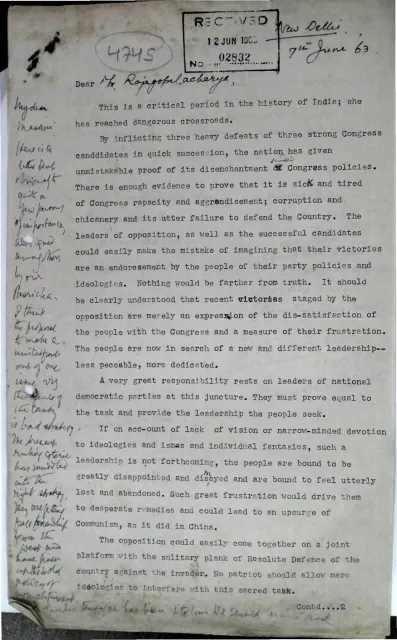
This two-page letter, dated June 1963 and addressed to C. Rajagopalachari, presents India as being at a dangerous political crossroads. The sender interprets three recent defeats of Congress candidates as evidence of public dissatisfaction with Congress policies, corruption, self-aggrandisement, and failure to defend the country. The letter cautions opposition leaders not to mistake these victories for popular endorsement of their own ideologies; instead, it sees them as expressions of frustration and a search for more dedicated leadership.
The letter urges leaders of democratic opposition parties to overcome ideological differences and establish a common platform centred on resolute national defence. It warns that failure to provide effective leadership could deepen public disillusionment and produce support for communism, invoking China as an example. The second page calls for democratic parties to unite to defeat what the sender describes as a consolidating “Congress-Communist Axis.” Handwritten annotations and signatures appear on both pages, but the sender’s identity remains uncertain.
Key points
- The letter describes India in 1963 as facing a critical political juncture.
- Recent defeats of three Congress candidates are presented as evidence of public disenchantment with Congress rule.
- Opposition victories are interpreted as protest votes rather than endorsements of opposition ideologies.
- The public is described as seeking less fallible and more dedicated leadership.
- Democratic opposition parties are urged to unite around national defence despite ideological differences.
- The letter warns that political frustration could drive people toward communism, as allegedly happened in China.
- The sender calls for a joint formula to defeat a perceived Congress-Communist alliance.
Metadata and summary are AI-extracted from the source PDF and reviewed for editorial accuracy. The original work is available via the Read PDF tab above (where present); paragraph-level citation inside the PDF is deferred to a future engagement.