
essay · report
General Secretary’s Report
SWATANTRA PARTY · Madras · 1973
49 pages
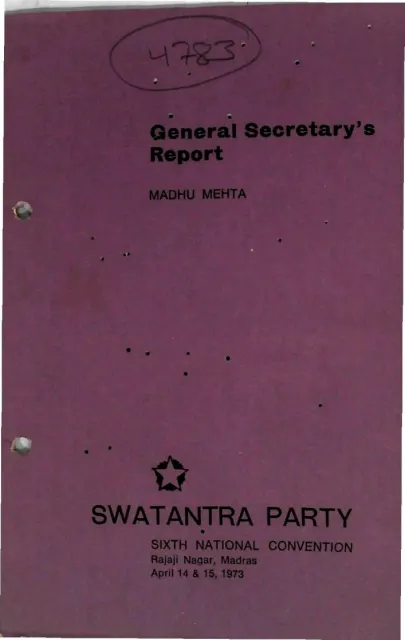
Summary
In the rendered pages, Madhu Mehta presents a factual report on the Swatantra Party’s activities from October 1968 to March 1973, prepared for the Sixth National Convention in Madras. The report opens by recalling C. Rajagopalachari’s death and reviews the Fifth National Convention at Bhubaneswar, where 702 delegates from 17 states amended the Party constitution, adopted resolutions on economic and political matters, and proposed a “Mid-term Manifesto” to make parties report on their performance between general elections. In the rendered pages, the report portrays the Party as internally candid and organisationally disciplined while acknowledging its declining electoral strength.
In the rendered pages, the account of the 1969, 1971, and 1972 elections combines results with a candid diagnosis of failure. The Swatantra Party contested fewer seats because of limited resources, entered an ultimately ineffective Democratic Front arrangement, and fell from 44 Lok Sabha seats in 1967 to 8 in 1971; it later contested 308 state-assembly seats and won 16. Mehta attributes the setbacks to the absence of a common programme, disloyal alliance partners, violence, money power, bloc voting, and misuse of government machinery. In the rendered pages, the Party’s response is to strengthen its own organisation, defend constitutional liberties, oppose totalitarianism and Marxist values, broaden its appeal, and recruit younger leadership.
In the rendered pages, the report also traces internal elections, changes in leadership, General Council meetings, regional reorganisation in Andhra and Assam, and the adoption of a nine-point programme addressing agriculture, housing, employment, consumer goods, labour, minorities, press freedom, social justice, and political education. The discussion repeatedly presents organisational renewal and a principled opposition as necessary to democratic survival. The remaining pages of the 49-page report were not rendered, so this summary does not cover the report’s later sections.
Key points
- In the rendered pages, the report covers the Swatantra Party’s activities from October 1968 to March 1973.
- In the rendered pages, the Fifth National Convention amended the Party constitution and endorsed a mid-term reporting mechanism for political parties.
- In the rendered pages, the Party’s electoral decline is documented through results from the 1969, 1971, and 1972 elections.
- In the rendered pages, Mehta attributes electoral failure to weak resources, alliance breakdown, violence, money power, bloc voting, and misuse of government machinery.
- In the rendered pages, the Party argues that it must stand on its own organisational and ideological legs rather than rely on unstable alliances.
- In the rendered pages, leadership changes bring H. M. Patel, Piloo Mody, and younger office-bearers into prominence.
- In the rendered pages, the Party combines constitutional opposition to authoritarianism with economic and agricultural policy proposals.
Metadata and summary are AI-extracted from the source PDF and reviewed for editorial accuracy. The original work is available via the Read PDF tab above (where present); paragraph-level citation inside the PDF is deferred to a future engagement.
Related across the archive
 Primary workGeneral Secretary’s Report
 Primary workDraft Minutes of the 7th meeting of the National Executive held on Friday, Saturday and Sunday, April 16, 17, and 18, 1971 at the Ritz Hotel, Bombay.
 Primary workThe President's Report on political developments since the General Council meeting in Madras on July 21, 1970
 OpinionThe Swatantra Way for Forging a Formidable Coalition
 ExcerptThe Essence of Democracy