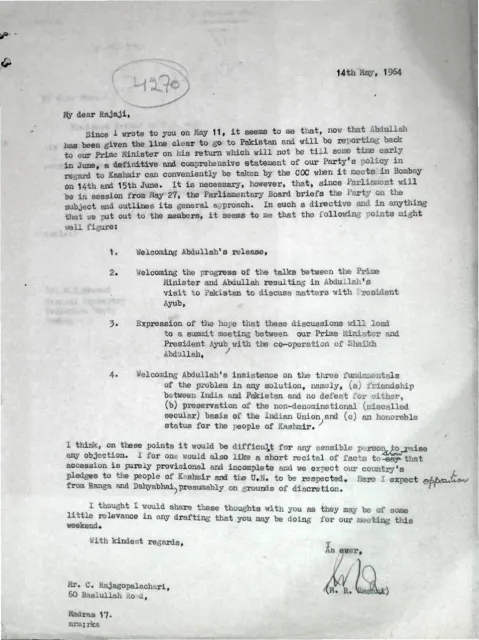
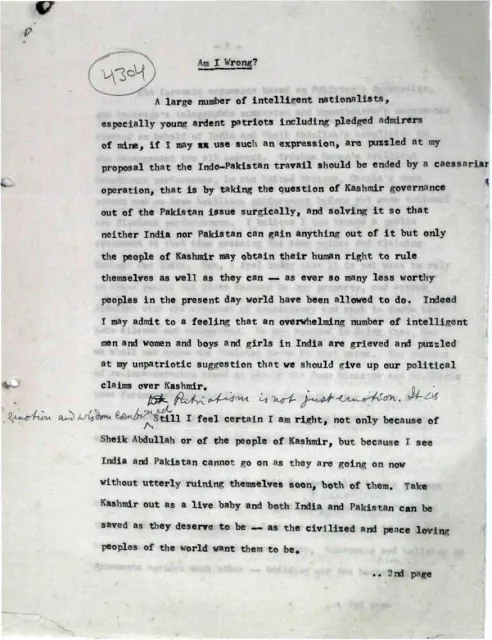
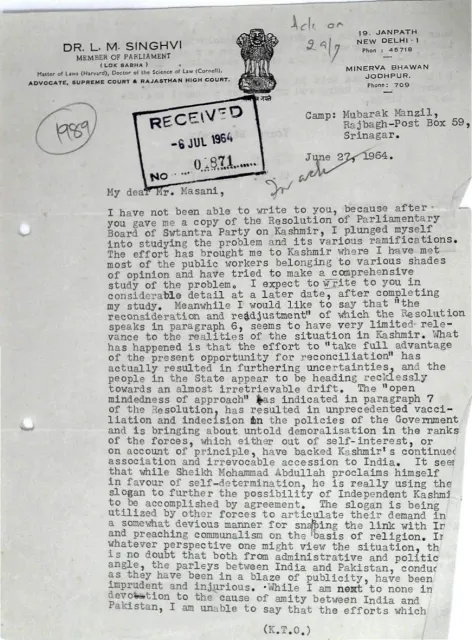
resolution
Resolution of Parliamentary Board
2 pages
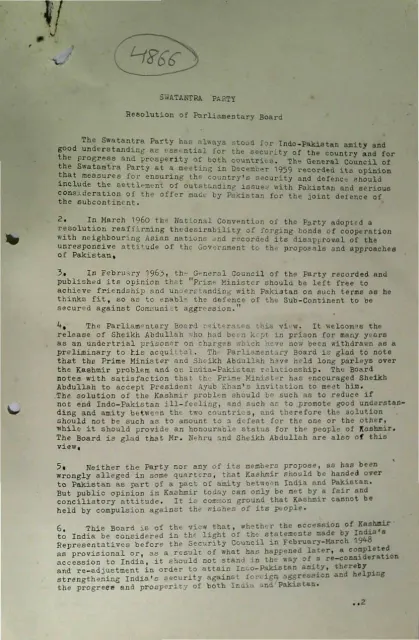
Summary
This two-page Swatantra Party Parliamentary Board resolution argues that Indo-Pakistan amity is essential to the security, progress, and prosperity of both countries. It reiterates earlier party positions from December 1959, March 1960, and February 1963 that India should seek friendship and understanding with Pakistan while settling outstanding disputes and strengthening the subcontinent’s defence against foreign aggression. The resolution welcomes Sheikh Abdullah’s release and supports discussions between him, Prime Minister Jawaharlal Nehru, and President Ayub Khan as a possible route toward reducing Indo-Pakistan hostility and establishing an honourable status for Kashmir.
The document rejects the allegation that the Swatantra Party wants Kashmir handed over to Pakistan, but maintains that Kashmiri opinion cannot be secured through coercion. It calls for a possible reconsideration or adjustment of India’s position on Kashmir if that would promote Indo-Pakistan amity, and insists that no political decision concerning national security should be regarded as irreversible. Its final provision diagnoses mutual mistrust and fear in India and Pakistan as a self-reinforcing cycle, urging both the Prime Minister and the Congress Party to seize the opportunity for reconciliation.
Key points
- The resolution presents Indo-Pakistan friendship as necessary for the security and prosperity of both countries.
- It endorses negotiations over outstanding Indo-Pakistan issues and recalls earlier Swatantra Party resolutions supporting cooperation with neighbouring Asian nations.
- It welcomes Sheikh Abdullah’s release and supports his discussions with Jawaharlal Nehru and Ayub Khan concerning Kashmir and bilateral relations.
- It denies that the party seeks to transfer Kashmir to Pakistan, while arguing that Kashmiri public opinion cannot be held by coercion.
- It leaves open a reconsideration or adjustment of India’s position on Kashmir in the interest of Indo-Pakistan amity.
- It argues that security policy should remain open to revision rather than being treated as final or irreversible.
- It describes mutual mistrust and fear in India and Pakistan as a vicious cycle that must be broken through courage, sacrifice, and determined resistance to forces sustaining hostility.
Metadata and summary are AI-extracted from the source PDF and reviewed for editorial accuracy. The original work is available via the Read PDF tab above (where present); paragraph-level citation inside the PDF is deferred to a future engagement.