report
Indian Human Rights hearing before US Congress
Washington · 1975
4 pages
Summary
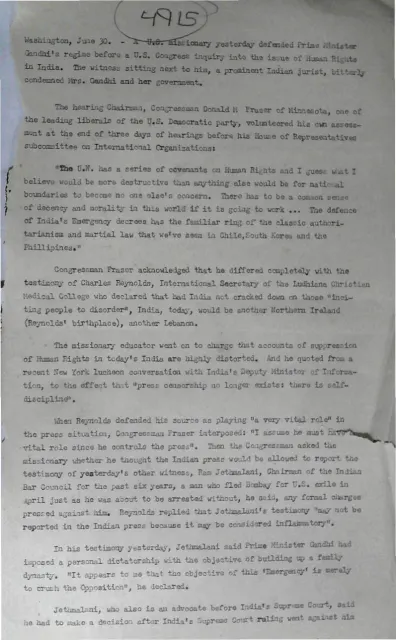
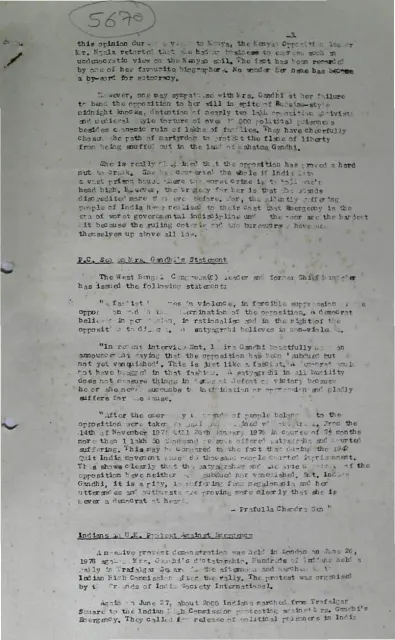
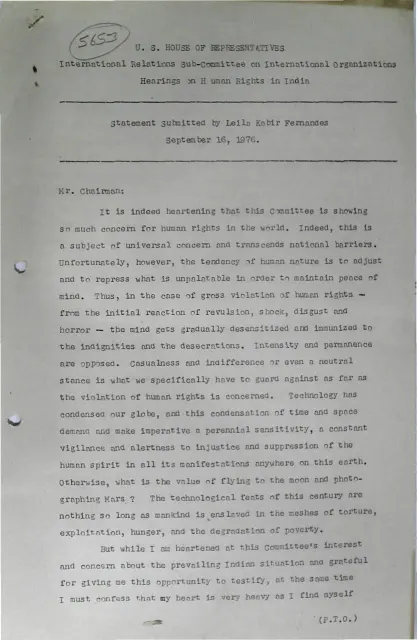
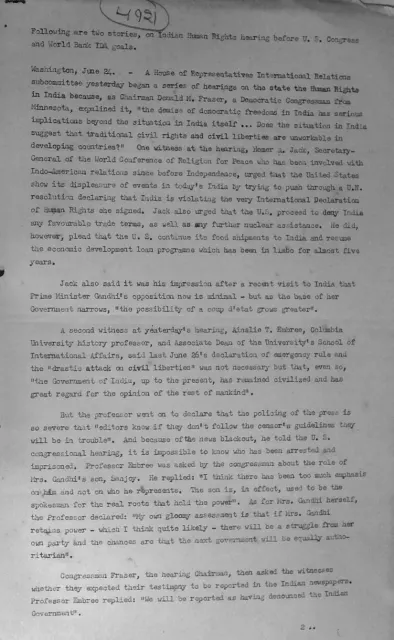
This four-page English archival document contains two untitled reports from Washington, dated June 24 and June 25, 1975, on U.S. congressional hearings concerning human rights in India during the Emergency. The first report describes testimony by Homer A. Jack and Ainslie T. Embree before a House International Relations Subcommittee chaired by Congressman Donald M. Fraser. Jack urged the United States to condemn India’s rights violations, deny favourable trade terms and further nuclear assistance, while continuing food shipments and reviving development loans. Embree described severe press censorship, uncertainty about arrests, and the possible authoritarian consequences of a return to power by Indira Gandhi. The report also records planned witnesses and Fraser’s earlier hearings on human rights in other countries.
The second report covers testimony by Ved Nanda, Dr. Jagit Singh Chohan, and Bishop James K. Mathews. Nanda cited alleged torture of political prisoners and urged U.S. pressure through international forums, the United Nations, and the World Bank, while maintaining economic and food aid. Chohan described restrictions imposed on him and argued that psychological torture through drugs had impaired prominent prisoners. Mathews took a more sympathetic view of the Emergency, recommending that the United States encourage India to restore democracy through diplomatic reminders; Nanda challenged the claim that the emergency restrictions were merely temporary by pointing to constitutional changes. The pages do not identify the document’s author, publisher, issuing organisation, or exact source publication.
Key points
- The document reports U.S. congressional hearings on human rights in India during the 1975 Emergency.
- Witnesses and the committee chair debated whether the United States should use trade, nuclear assistance, food aid, development loans, and international institutions to influence India.
- Testimony described press censorship, political arrests, alleged torture, and uncertainty caused by a news blackout.
- Ainslie T. Embree warned that the concentration of power around Indira Gandhi could produce an authoritarian successor government.
- Ved Nanda urged the United States to raise India’s rights violations at international conferences and end nuclear transactions while maintaining food and economic aid.
- Bishop James K. Mathews argued that the Emergency may have been necessary and advised diplomatic encouragement rather than punitive pressure.
- The reports identify planned additional witnesses and note a forthcoming Washington demonstration for freedom in India.
Metadata and summary are AI-extracted from the source PDF and reviewed for editorial accuracy. The original work is available via the Read PDF tab above (where present); paragraph-level citation inside the PDF is deferred to a future engagement.