
letter
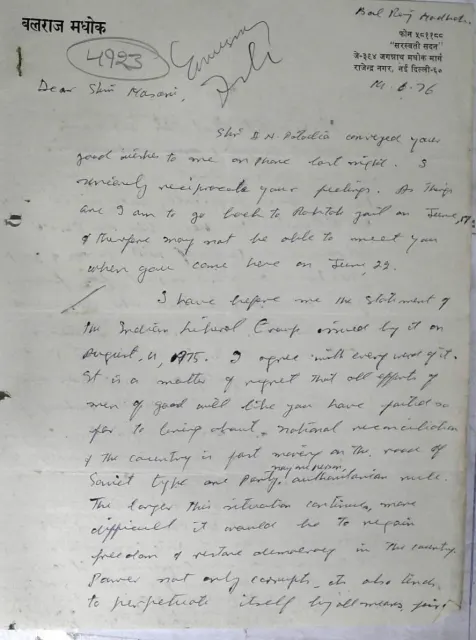
Letter to Mr Minoo Masani
New Delhi · 1976
4 pages
Summary
This four-page English letter, dated 14 June 1976 and addressed to Minoo Masani, opens with Balraj Madhok’s assessment of India’s political situation. Madhok argues that the country is moving toward a Soviet-type one-party and authoritarian system, and that the longer this continues, the harder it will be to restore freedom and democracy. He criticises Jayaprakash Narayan’s failure to play a constructive role after his unconditional release, while warning that power seeks to perpetuate itself through force and manipulation.
The letter then sets out six propositions for a proposed new party. Madhok calls for ideological clarity rather than a coalition held together by slogans, an appeal to peasants and the self-employed, and an unequivocal commitment to democratic norms. He links democracy to freedom of thought, freedom of living, limited state interference, and rejection of total planning. Drawing on Gandhi and an ancient account of the Licchavi republic, he presents democracy as evolutionary and rooted in tradition. The letter rejects total revolution, violence, clandestine activity, and authoritarian discipline, concluding that the Sangarsh Samiti should be dissolved and that the struggle for civil liberties should proceed through peaceful, nonviolent, constitutional political education.
Key points
- Madhok describes India as moving toward a Soviet-type one-party and authoritarian political order.
- He criticises Jayaprakash Narayan’s post-release political conduct and calls for a gradual restoration of democracy.
- The proposed new party should have a distinct ideology and programme rather than rely on populist slogans or an anti-Congress coalition.
- The party should appeal especially to peasants, self-employed people, artisans, shopkeepers, and those committed to democratic and Gandhian values.
- Democracy requires freedom of thought and expression, freedom of living, and limited state control over economic life.
- Madhok rejects total planning, total revolution, violence, clandestine action, and unconstitutional methods.
- The restoration of civil liberties should be pursued through peaceful, nonviolent, constitutional political education.
Metadata and summary are AI-extracted from the source PDF and reviewed for editorial accuracy. The original work is available via the Read PDF tab above (where present); paragraph-level citation inside the PDF is deferred to a future engagement.
Related across the archive
 Primary workChanging Circumstances and Bharatiya Jana Sangh
 Primary workText of letter addressed to the Prime Minister by Mr. Jayaprakash Narayan while in detention on July 21, 1975.
 Primary workSATYASAMACHAR
 ExcerptDangerous Counter Philosophy - Piloo Mody
 OpinionFreedom First's Resistance to Indira Gandhi's Emergency