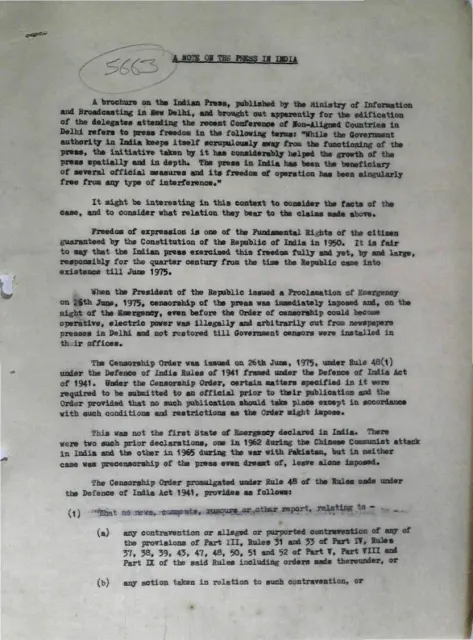
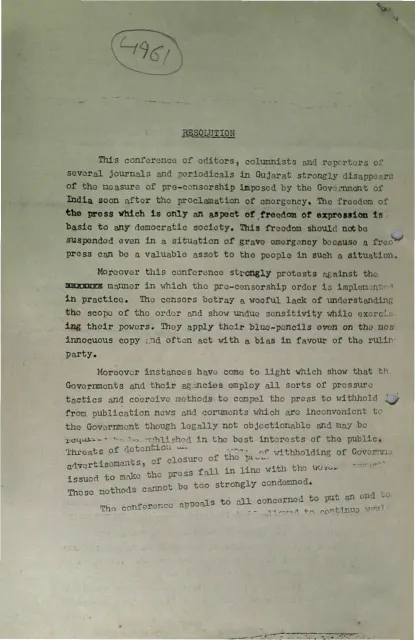
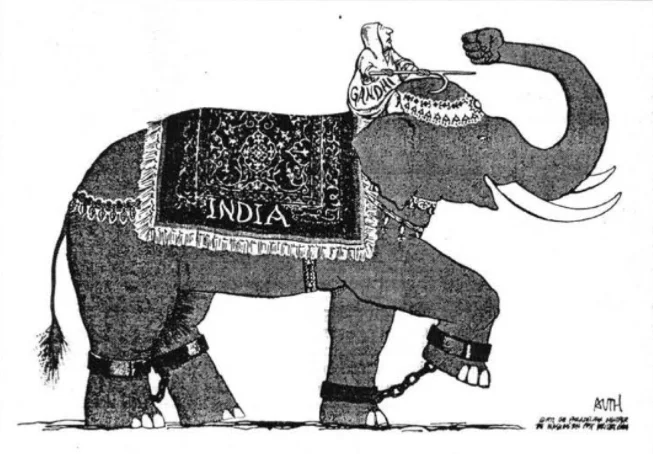
essay
GOVERNMENT VS THE PRESS IN INDIA
1976
5 pages
Summary
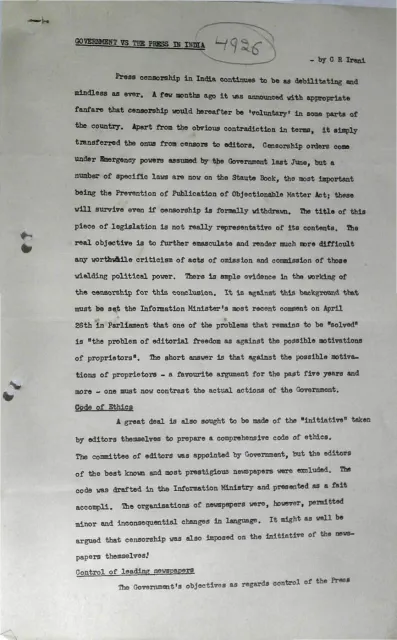
In this May 1976 essay, C R Irani argues that press censorship under the Emergency has not meaningfully receded but has shifted from government censors to newspaper editors. He contends that emergency orders and the Prevention of Publication of Objectionable Matter Act are designed to make criticism of those exercising political power increasingly difficult. The essay also challenges the government’s claim that press freedom is threatened primarily by proprietors, arguing that the government’s own conduct provides the more serious threat.
Under the headings “Code of Ethics” and “Control of leading newspapers,” Irani describes an officially sponsored editorial code, pressure on the Indian Express Group, government influence over newspaper boards, and attempts to remove or transfer senior journalists. He then discusses the consolidation of the Press Trust of India and United News of India into a government-controlled news agency, the economic pressure created by newsprint pricing, and the broader danger to civil liberties. The essay concludes by rejecting the argument that India’s poverty or distinctive circumstances justify restrictions on freedom, and invokes Aleksandr Solzhenitsyn’s warning that people accustomed to freedom may lose the will to defend it.
Key points
- Censorship is presented as continuing under Emergency powers, even where it is described as “voluntary.”
- The Prevention of Publication of Objectionable Matter Act is portrayed as a durable legal instrument for weakening press criticism.
- The government-sponsored code of ethics is described as an editorial constraint rather than an independent initiative by newspapers.
- Government pressure over newspaper ownership, boards, editors, and managers is illustrated through examples involving the Indian Express Group and The Statesman.
- The merger and reorganisation of India’s leading news agencies is presented as the creation of a government-controlled monopoly.
- Equalised newsprint pricing is criticised as an economic measure benefiting the State Trading Corporation at the expense of newspapers and journalists.
- The conclusion connects press freedom with indivisible human liberty and rejects trading freedom for economic development.
Metadata and summary are AI-extracted from the source PDF and reviewed for editorial accuracy. The original work is available via the Read PDF tab above (where present); paragraph-level citation inside the PDF is deferred to a future engagement.