pamphlet
A NOTE ON THE PRESS IN INDIA
14 pages
Summary
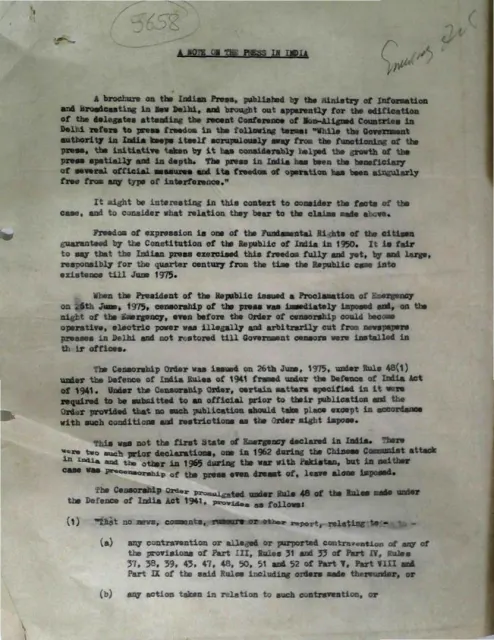
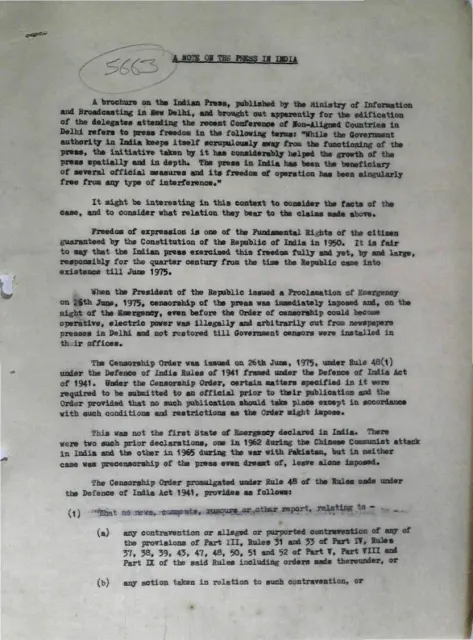
A Note on the Press in India examines press censorship during the Indian Emergency declared in June 1975. It contrasts the Ministry of Information and Broadcasting’s claim that the Indian press remained free with the immediate imposition of censorship, the cutting of electricity to newspaper offices, compulsory submission of material for prior scrutiny, and restrictions issued under the Defence of India Rules, the Maintenance of Internal Security Act, and constitutional Emergency provisions. The pamphlet argues that censorship was applied far beyond the prevention of genuinely dangerous material, extending to criticism of government policy, judicial decisions, detentions, transfers of judges, and even reports of individual arrests and deaths in detention.
The document details the Bombay High Court’s decision in the Freedom First case involving Minoo Masani, emphasizing limits on censorial discretion and the court’s insistence that the press must remain a forum for competing political and economic ideas. It then records telephone censorship instructions, pressure on newspaper owners and editors, attempts to take over or control major newspapers, the removal of editors, new press ordinances, the suppression of periodicals, restrictions on foreign correspondents, and the creation of government-controlled news agencies. The closing pages reproduce a P.E.N. resolution defending unhampered communication and opposing censorship. No author, publisher, place, or year is printed in the rendered pamphlet.
Key points
- The pamphlet challenges the official claim that the Indian press operated without interference during the Emergency.
- It describes prior censorship, electricity cutoffs, detention-related restrictions, and bans on reporting politically sensitive events.
- The Freedom First case is presented as a judicial affirmation that censorial decisions are reviewable and must follow the purpose of the Censorship Order.
- The Bombay High Court is quoted as distinguishing legitimate press regulation from forced conformity and suppression of dissent.
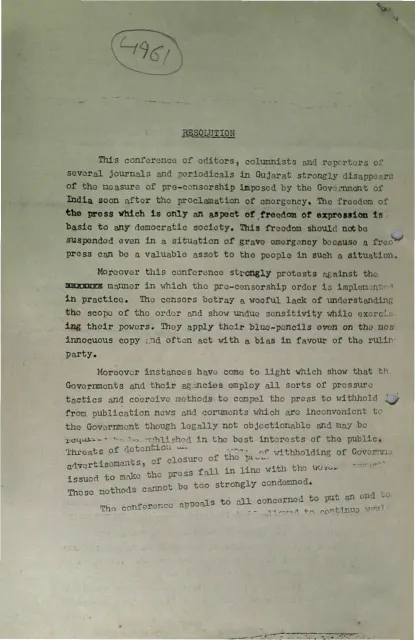
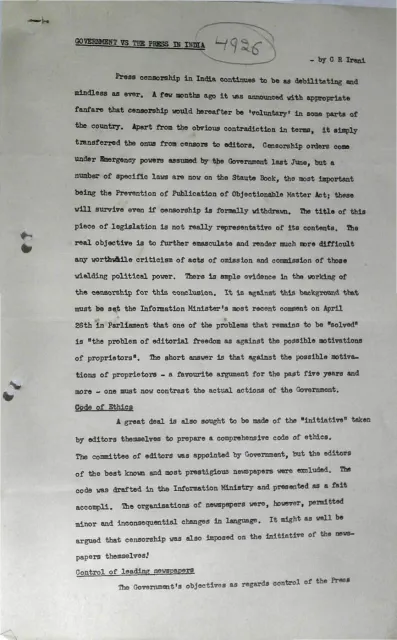
- The pamphlet documents pressure on editors, newspaper owners, periodicals, printing presses, and foreign correspondents.
- It argues that control of news agencies and newspapers threatened both public reasoning and democratic accountability.
- The final P.E.N. resolution calls for a free press and asks the President of India to revoke constraints on free expression.
Metadata and summary are AI-extracted from the source PDF and reviewed for editorial accuracy. The original work is available via the Read PDF tab above (where present); paragraph-level citation inside the PDF is deferred to a future engagement.