pamphlet
A Note on the Press in India
published by the Ministry of Information and Broadcasting in New Delhi · New Delhi · 1976
14 pages
Summary
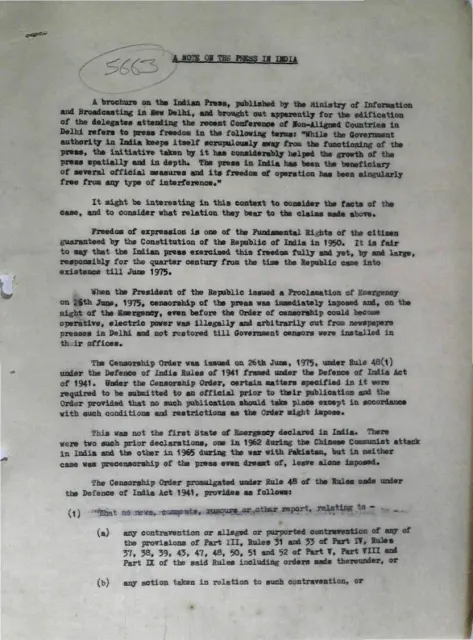
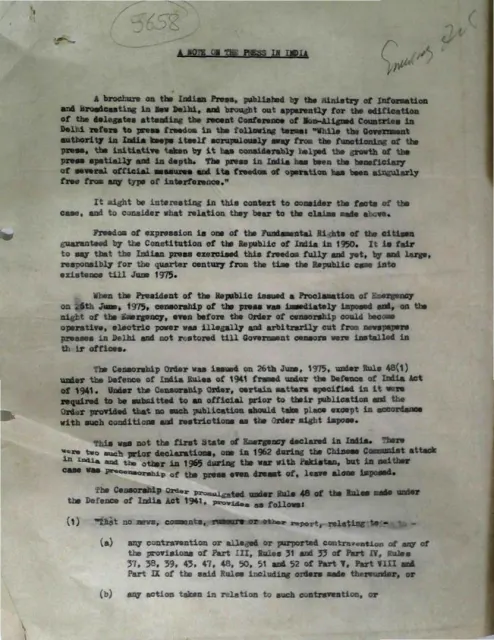
This brochure, published by the Ministry of Information and Broadcasting in New Delhi, examines press censorship during India’s Emergency beginning on 25 June 1975. It contrasts the constitutional guarantee of freedom of expression with the immediate imposition of censorship, the cutting of electricity to newspaper presses in Delhi, and the Censorship Order issued under the Defence of India Rules. The text reproduces the order’s restrictions and argues that the press had previously operated with considerable freedom, including during the 1962 and 1965 emergencies.
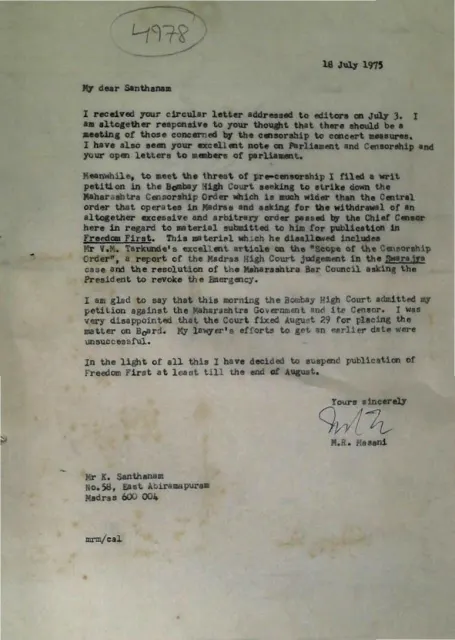
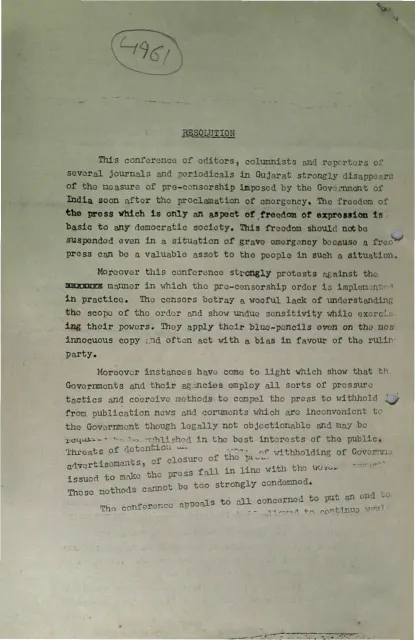
A substantial section discusses the legal challenge brought by Minoo Masani through Freedom First. Drawing on S. J. Sorabjee’s account and the Bombay High Court judgment, it presents judicial principles limiting the censor’s discretion and insists that the press must remain a forum for competing political, economic, and social ideas. The later pages catalogue telephone censorship, pressure on newspapers and editors, new press ordinances, detention and intimidation of journalists, the suppression of periodicals, government control of news agencies, and the expulsion of foreign correspondents. The brochure concludes with the P.E.N. resolution defending unhampered communication and opposing arbitrary censorship.
Key points
- The brochure describes the Emergency-era censorship regime introduced after 25 June 1975.
- It reproduces restrictions requiring news and commentary to be submitted to authorised censoring officers before publication.
- The Freedom First case is presented as a successful legal challenge to excessive censorial discretion.
- The Bombay High Court is quoted as distinguishing legitimate regulation from forced conformity and suppression of dissent.
- Examples of telephone censorship include bans on reporting arrests, judicial transfers, and other politically sensitive subjects.
- The text alleges coordinated pressure to control major newspapers, remove editors, and establish government influence over news agencies.
- It records the closure or suppression of periodicals including Opinion, Janta, Seminar, Bhoomi Putra, and Sadhana.
- The concluding P.E.N. resolution links freedom of expression with voluntary restraint against deliberate falsehood and distortion.
Metadata and summary are AI-extracted from the source PDF and reviewed for editorial accuracy. The original work is available via the Read PDF tab above (where present); paragraph-level citation inside the PDF is deferred to a future engagement.