essay
MRS GANDHI'S OPPOSITION: THE ETERNAL DILEMMA
THE ETERNAL DILEMMA
4 pages
Summary
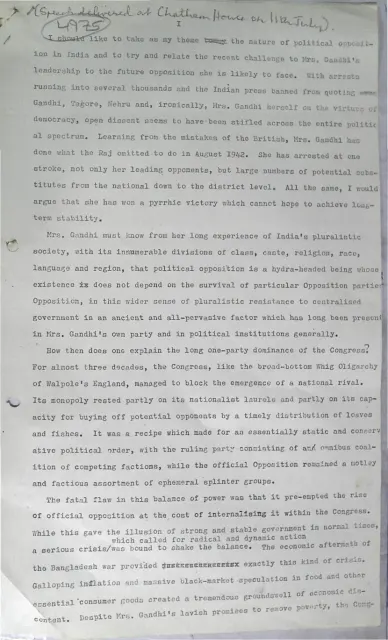
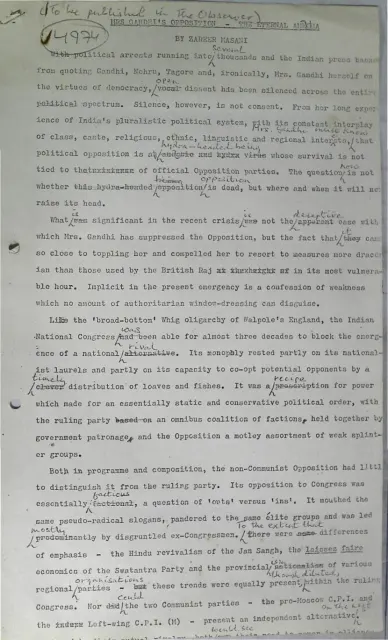
In this four-page typescript, Zareer Masani examines the political crisis surrounding Indira Gandhi’s Emergency and argues that the suppression of opposition reflects governmental weakness rather than strength. The essay opens by distinguishing silence from consent and locates opposition in India’s pluralistic social structure, where class, caste, religious, ethnic, linguistic, and regional interests cannot be permanently eliminated by repressing official opposition parties. Masani compares the Congress system to the “broad-bottom” Whig oligarchy of Walpole’s England: its durability rested on national prestige, patronage, co-option, and an umbrella coalition that left the opposition fragmented and ideologically diffuse.
Masani attributes the collapse of this political equilibrium to the convergence of economic crisis, paralysis within Congress, and Jayaprakash Narayan’s anti-corruption campaign. He argues that the Emergency has pre-empted an immediate uprising but driven resistance underground rather than eradicated it. Indira Gandhi, in his account, faces a dilemma: reforms require mass support and new instruments of change, yet the party, bureaucracy, military, and middle-class interests on which she relies are likely to resist genuine reform. The essay concludes that opposition in India’s pluralistic society will continue to proliferate through passive resistance, slow erosion, and sudden eruption. The pages are a political analysis of the Emergency and its opposition, not a full account of the wider historical context.
Key points
- The essay argues that political silence during the Emergency should not be mistaken for popular consent.
- India’s pluralistic social structure gives opposition a basis beyond the survival of formal opposition parties.
- Congress dominance is explained through national prestige, patronage, co-option, and its broad coalition of factions.
- Economic crisis, internal Congress conflict, and Jayaprakash Narayan’s anti-corruption campaign destabilized the established balance of power.
- The opposition’s convergence under Jayaprakash Narayan gave it political legitimacy despite the weakness of its constituent parties.
- Arrests and repression can delay or drive underground the opposition but cannot remove its social foundations.
- Indira Gandhi’s reform programme is trapped by her dependence on the party, bureaucracy, security forces, and middle-class interests that resist structural change.
Metadata and summary are AI-extracted from the source PDF and reviewed for editorial accuracy. The original work is available via the Read PDF tab above (where present); paragraph-level citation inside the PDF is deferred to a future engagement.