speech
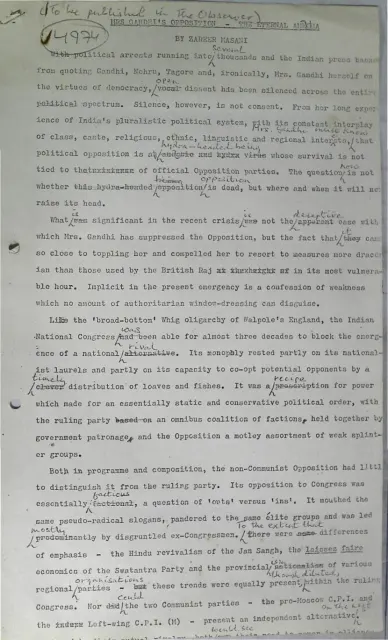
A Speech Delivered at Chatham home
1975
3 pages
Summary
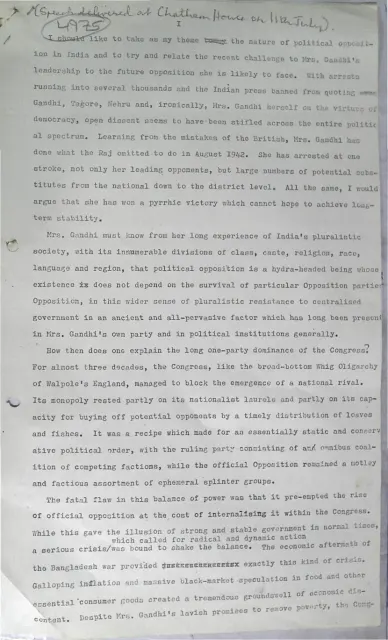
This July 1975 speech, identified from a handwritten heading as delivered at Chatham House, examines political opposition in India during the Emergency. It argues that Indira Gandhi’s mass arrests and suppression of dissent represent a “pyrrhic victory”: the measures may temporarily neutralise opponents but cannot provide long-term political stability. The speech links the crisis to the Congress’s long one-party dominance, its nationalist legitimacy, and its ability to absorb or marginalise potential rivals rather than permit an effective opposition. It also stresses that opposition is rooted in India’s pluralistic society and cannot be eliminated simply by repressing particular parties or leaders.
The speech attributes the immediate opposition challenge to the economic aftermath of the Bangladesh war, inflation, black-market speculation, corruption, and factionalism within Congress, as well as Jayaprakash Narayan’s moral authority and return from political retirement. It presents repression as evidence of governmental weakness and argues that underground resistance will regroup through regional and ideological networks. The concluding pages portray Gandhi as trapped between the need to retain the support of the Congress, bureaucracy, and security forces and the need to recover popular legitimacy: the same entrenched interests, the speech argues, would resist genuine reform. It ends by describing passive resistance as deeply rooted in Indian society and likely to persist in changing forms.
Key points
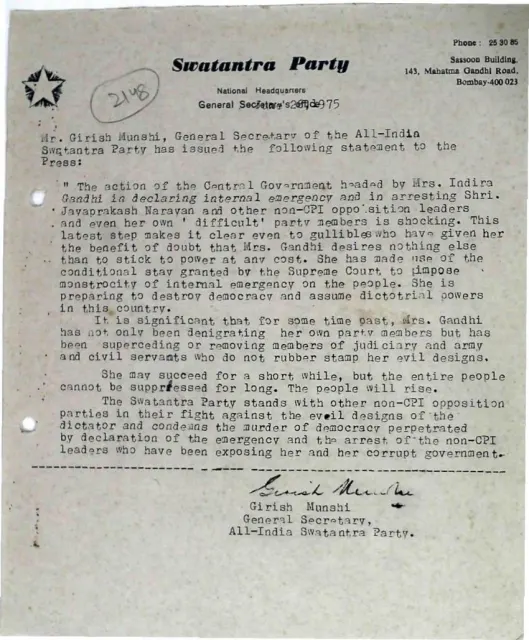
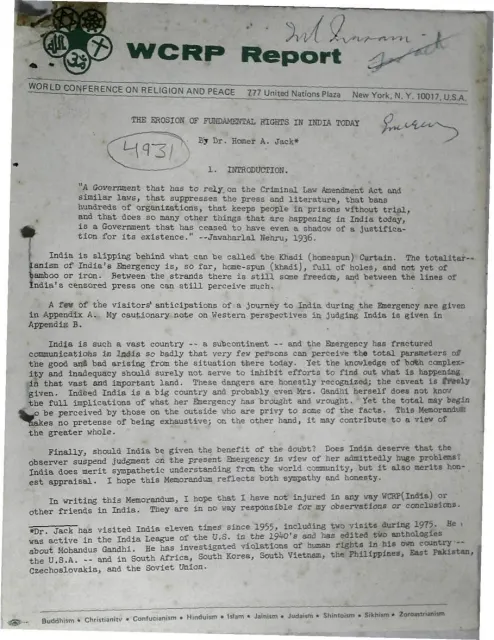
- The Emergency’s arrests and press restrictions are presented as an attempt to suppress political opposition rather than resolve its underlying causes.
- The speech argues that opposition is a persistent feature of India’s socially pluralistic society and cannot be abolished by eliminating particular parties.
- Congress’s long dominance is attributed to nationalist legitimacy, patronage, factional management, and the prevention of a nationally credible rival.
- Economic crisis, inflation, black-market speculation, corruption, and factionalism weakened Congress’s administrative and political position.
- Jayaprakash Narayan’s return gave the opposition moral legitimacy and helped unite forces inside and outside Congress.
- Repression is interpreted as a confession of weakness, while underground opposition is expected to regroup in Gujarat, Tamil Nadu, and Bihar.
- Indira Gandhi is depicted as constrained by the Congress, bureaucracy, military, and security forces, all of which could obstruct meaningful reform.
- Passive resistance is described as a durable social force that may alternate between gradual erosion and sudden eruption.
Metadata and summary are AI-extracted from the source PDF and reviewed for editorial accuracy. The original work is available via the Read PDF tab above (where present); paragraph-level citation inside the PDF is deferred to a future engagement.