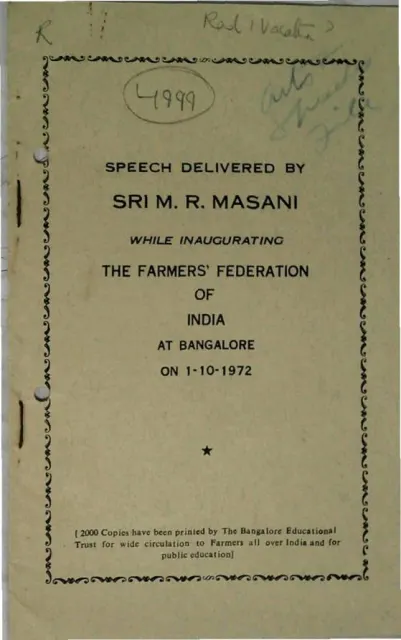
speech · inaugural
THE FARM- A BASTION OF FREEDOM
By Minoo Masani
2000 Copies have been printed by The Bangalore Educational Trust for wide circulation to Farmers all over India and for public education · Bangalore · 1972
15 pages
Summary
In this inaugural speech to the Farmers’ Federation of India in Bangalore on 1 October 1972, M. R. Masani presents the farm as a “bastion of freedom” and argues that the survival of India’s peasantry is a national, economic, and constitutional issue rather than a matter of party politics. He credits farmers with producing the Green Revolution and contends that government policy has instead neglected agriculture by diverting resources toward heavy industry, while Marxist influence has treated the independent farmer as an enemy of collectivism.
Masani’s central target is ceiling legislation. He distinguishes India’s policy from the compensatory, investment-oriented land ceilings adopted in Japan and Taiwan, arguing that India’s system will produce neither viable holdings nor employment. He warns that progressively smaller holdings could make peasant farming impossible and create the conditions for compulsory collective farming. The speech closes with an appeal for a non-party farmers’ organisation, cooperation between rural and urban middle classes, constitutional resistance, and peaceful civil disobedience if farmers’ land is taken. Masani also rejects demands for urban ceilings, describing them as a divisive strategy that benefits the “New Class” and ultimately threatens both farmers and industrialists.
Key points
- Masani frames the farmer as a defender of India’s prosperity and freedom, and the Farmers’ Federation as a national rather than partisan organisation.
- He attributes the Green Revolution to farmers, favourable monsoons, and agricultural effort rather than to New Delhi’s direction.
- He criticises planning priorities that diverted resources from agricultural inputs, irrigation, roads, and rural development to heavy industry.
- He argues that Indian ceiling legislation will not solve landlessness or rural unemployment and may undermine productive peasant farming.
- He presents Marxist hostility to the farmer as rooted in the belief that independent landholding is incompatible with collectivism.
- He warns that repeated reductions in permissible holdings could prepare the way for collective farming and nationalisation of land.
- He urges rural and urban groups to reject mutually destructive demands for ceilings and to cooperate in defence of property, production, and constitutional freedoms.
- He calls for peaceful resistance and civil disobedience if the state attacks farmers’ land, while asking the Federation to remain independent of political parties.
Metadata and summary are AI-extracted from the source PDF and reviewed for editorial accuracy. The original work is available via the Read PDF tab above (where present); paragraph-level citation inside the PDF is deferred to a future engagement.