legal filing · report
A Meetings of Executive Committee
SWATANTRA PARTY PARLIAMENTARY OFFICE · New Delhi · 1964
2 pages
Summary
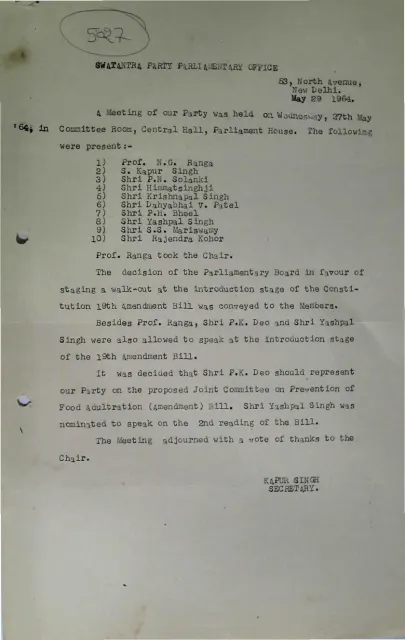
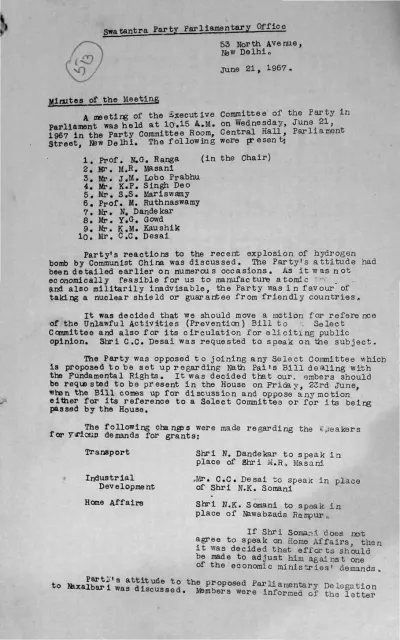
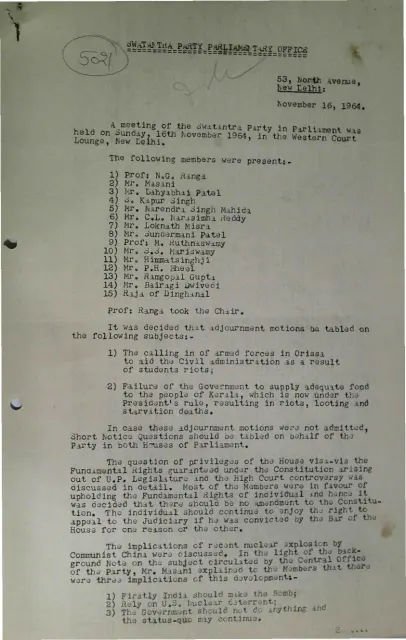
This two-page office record documents a Swatantra Party meeting held on 16 November 1964 at the Western Court Lounge in New Delhi, chaired by Prof. N. G. Ranga. Members decided to raise adjournment motions concerning the use of armed forces during student disturbances in Orissa and the Government’s failure to provide adequate food in Kerala. They also discussed the constitutional position of Fundamental Rights in relation to controversies involving the Uttar Pradesh Legislature and High Court, with members supporting continued judicial appeal by individuals convicted by a legislative House.
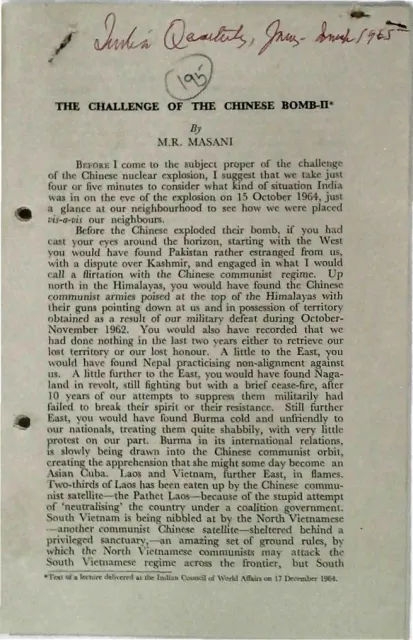
The meeting also considered the implications of China’s recent nuclear explosion and India’s strategic choices. Minoo Masani argued that India could not independently develop nuclear weapons while refusing to accept a U.S. deterrent, leaving reliance on U.S. nuclear protection as the practical alternative. Ranga opposed increasing Soviet influence in India’s defence establishments, citing the possibility of closer Soviet alignment with Communist China. The record assigns members to study several legislative matters, including Indo-Ceylonese relations, anti-corruption law, food adulteration, and electoral representation, and records opposition to the Government’s Essential Commodities Ordinance.
Key points
- The meeting was held on 16 November 1964 in New Delhi, with Prof. N. G. Ranga in the chair.
- The party planned parliamentary action on the deployment of armed forces during student riots in Orissa.
- Members criticised the Government’s handling of food shortages, riots, looting, and starvation deaths in Kerala.
- The record affirms the importance of Fundamental Rights and an individual’s right to appeal to the judiciary after conviction by a legislative House.
- Minoo Masani presented reliance on the U.S. nuclear deterrent as India’s practical alternative to developing its own bomb or remaining undefended.
- Prof. Ranga opposed expanding Soviet influence in India’s defence institutions because of possible Soviet rapprochement with Communist China.
- Members were assigned to study Indo-Ceylonese affairs, anti-corruption legislation, food adulteration, the People’s Representation Amendment Bill, and the Essential Commodities Ordinance.
Metadata and summary are AI-extracted from the source PDF and reviewed for editorial accuracy. The original work is available via the Read PDF tab above (where present); paragraph-level citation inside the PDF is deferred to a future engagement.