letter
Letter to Mr Minoo Masani
Hyderabad · 1959
2 pages
Summary
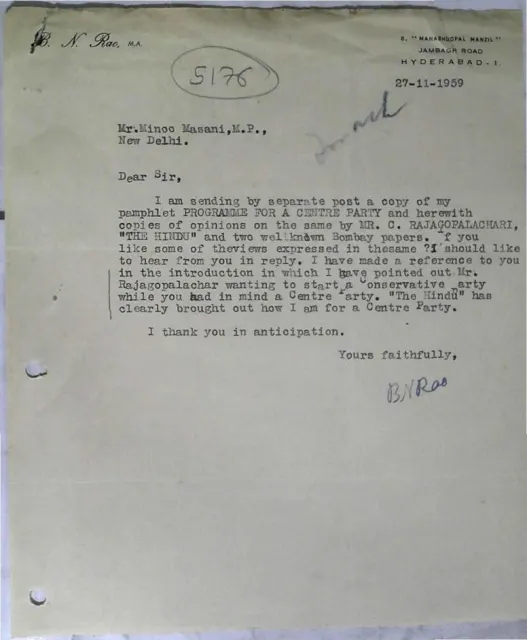
This letter, dated 27 November 1959 and sent by B. N. Rao from Hyderabad to Minoo Masani, accompanies a copy of Rao’s pamphlet Programme for a Centre Party. Rao asks Masani to consider the pamphlet’s arguments and refers him to an introduction defending a centre-oriented alternative to C. Rajagopalachari’s proposed conservative party. He also cites supportive comments from The Hindu and two Bombay newspapers.
The second page reproduces press notices describing the pamphlet’s case for a Centre Party as an alternative to the Swatantra Party. The proposed programme supports a mixed economy, coexistence between public- and private-sector enterprises, greater administrative decentralisation, more efficient public services, a realistic foreign policy, and a national government lasting at least five years. It also rejects both extreme individualism and communism, advocates state planning for public enterprises but not private ones, recommends profit-sharing, and proposes state-sponsored farm co-operatives for rural development. The press excerpts frame the pamphlet as a centrist response to communism, fascism, and the perceived overextension of state authority.
Key points
- B. N. Rao’s letter to Minoo Masani encloses and promotes the pamphlet Programme for a Centre Party.
- Rao contrasts his centre-party proposal with C. Rajagopalachari’s advocacy of a conservative party.
- The proposed Centre Party programme supports a mixed economy and coexistence between public and private enterprise.
- The programme calls for administrative decentralisation, more efficient public services, and a realistic foreign policy.
- It recommends a national government for at least five years and state planning limited to public-sector enterprises.
- The pamphlet advocates profit-sharing and state-sponsored farm co-operatives for rural development.
- Press summaries present the programme as rejecting both extreme individualism and communism while warning against excessive state power.
Metadata and summary are AI-extracted from the source PDF and reviewed for editorial accuracy. The original work is available via the Read PDF tab above (where present); paragraph-level citation inside the PDF is deferred to a future engagement.