essay · position paper
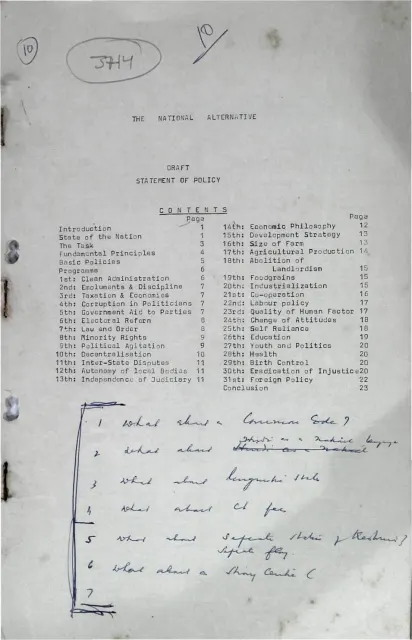
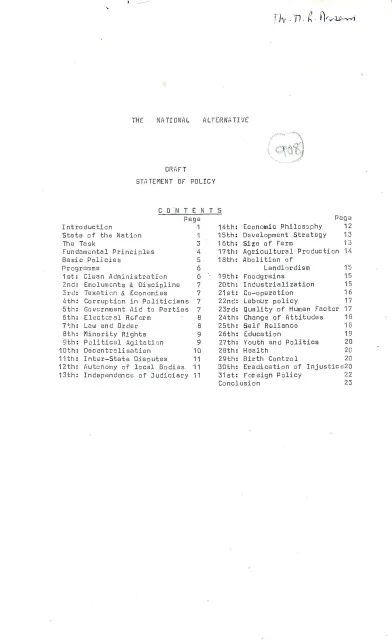
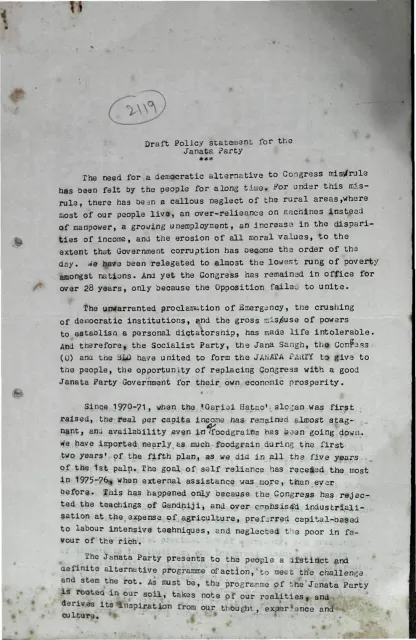
Draft Policy statement for the Janata Party
1976
10 pages
Summary
This ten-page draft policy statement presents the Janata Party as a democratic alternative to Congress rule, condemning the Emergency, the concentration of state power, corruption, rural neglect, unemployment, inequality and the erosion of civil liberties. It proposes the withdrawal of the Emergency, repeal of laws restricting civil liberties, restoration of press freedom and judicial review, immediate elections, and a comprehensive constitutional review by a popularly elected Constituent Assembly. Decentralisation is central to the programme: revenue and power would be transferred from the Centre to states and local institutions, including panchayats.
The economic programme rejects capital-intensive industrialisation, centralised planning and indiscriminate import substitution in favour of agriculture, labour-intensive cottage and small-scale industries, employment creation and greater self-reliance. It promises that at least 33 per cent of the capital budget would go to agriculture, alongside support for peasant proprietors, food security measures, worker profit-sharing and welfare protections for rural labour. The statement also addresses taxation, inflation, defence, youth and foreign affairs, advocating reduced government expenditure, progressive taxation, an independent foreign-policy course, closer relations with neighbouring countries and a South Asian common market. Mahatma Gandhi is the principal intellectual reference point, especially on self-government, limited state interference, individual responsibility and policies judged by their effect on the poor.
Key points
- The Janata Party frames itself as a united democratic alternative to Congress misrule and the Emergency.
- The programme calls for restoring civil liberties, press freedom, judicial review and immediate national elections.
- It proposes constitutional and electoral reform, including a popularly elected Constituent Assembly and decentralisation of revenue and power.
- Economic policy prioritises agriculture, rural employment, cottage industries and labour-intensive techniques over capital-intensive industrialisation.
- The statement advocates reduced government expenditure, monetary restraint, progressive taxation and cost-benefit tests for import substitution.
- Agricultural policy would direct at least 33 per cent of the capital budget to farming and support peasant proprietors, food security and rural purchasing power.
- The programme includes worker profit-sharing, protections for rural labour, youth representation, defence reform and vocational resettlement for ex-servicemen.
- Foreign policy would reduce dependence on power blocs, strengthen relations with neighbouring countries and pursue a common South Asian market.
Metadata and summary are AI-extracted from the source PDF and reviewed for editorial accuracy. The original work is available via the Read PDF tab above (where present); paragraph-level citation inside the PDF is deferred to a future engagement.