speech · convention address
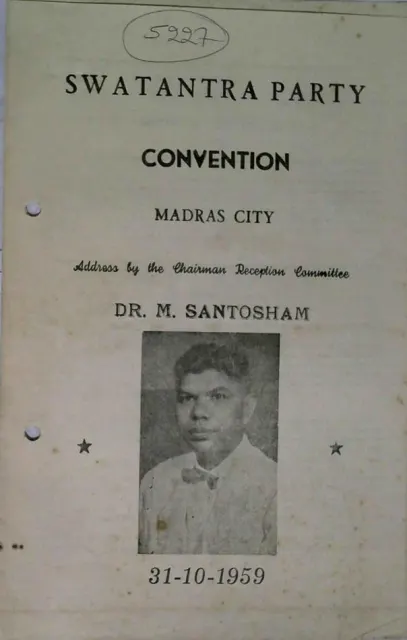
SWATANTRA PARTY CONVENTION
IMAYAM PRESS 543, Poonamallee High Road MADRAS.-3. · Madras · 1959
7 pages
Summary
This pamphlet reproduces Dr. M. Santosham’s address as Chairman of the Reception Committee at the Swatantra Party Convention in Madras City on 31 October 1959. He welcomes M. R. Masani, V. P. Menon, C. Rajagopalachari, and other delegates, presenting the new party as a response to what he describes as Congress’s political exhaustion, vested interests, and failure to improve living standards during twelve years of administration.
The address defines the Swatantra Party’s economic alternative around private enterprise, property and profit, employment, and relief for the poor without bureaucratic dependence. Santosham attacks socialism, public-sector expansion, controls, high taxation, and state planning, citing a reported rise in public-sector investment alongside a much smaller increase in private-sector investment between 1950–51 and 1953–54. He argues that private capital and enterprise offer greater employment potential and production, while insisting that the party’s aim is to make the poor prosperous rather than to defend wealth for its own sake. The speech closes with confidence that the convention will clarify Swatantra’s programme and serve the common citizen.
Key points
- The address welcomes delegates to the Swatantra Party’s Madras City convention of 31 October 1959.
- Congress is portrayed as weakened by internal exhaustion, vested interests, and an inability to offer reasoned opposition.
- The Swatantra Party presents itself as especially concerned with the poor and with improving access to basic needs and opportunities.
- The speech defends private capital, private enterprise, property rights, and profit-making as sources of employment and prosperity.
- Socialism, public-sector investment, controls, high taxation, and bureaucratic planning are criticized as reducing available capital and production incentives.
- The speaker rejects the charge that Swatantra is a reactionary party protecting the rich or restoring pre-socialist conditions.
- The address cites public-sector and private-sector investment figures for 1950–51 to 1953–54 as evidence in its critique of socialist policy.
- The convention is presented as an opportunity to remove doubts about the party’s programme and mobilize delegates for service to the common man.
Metadata and summary are AI-extracted from the source PDF and reviewed for editorial accuracy. The original work is available via the Read PDF tab above (where present); paragraph-level citation inside the PDF is deferred to a future engagement.