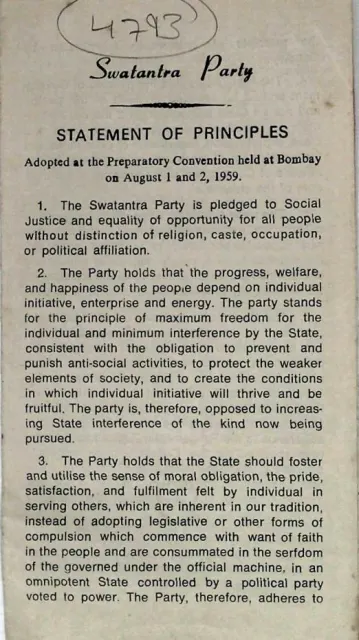
resolution
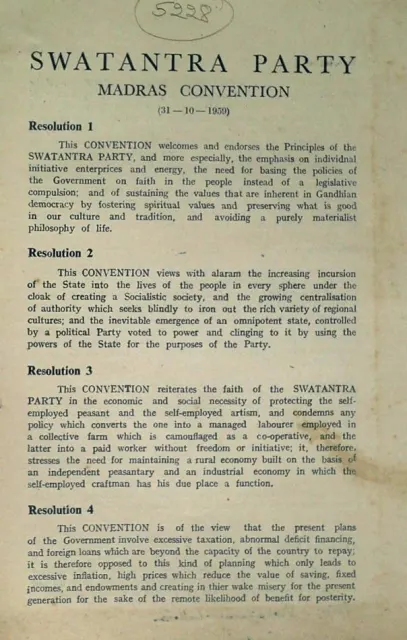
SWATANTRA PARTY MADRAS CONVENTION
Kalki Press, Kilpauk, Madras-10 · Madras · 1959
4 pages
Summary
This four-page English resolution booklet records fifteen resolutions adopted at the Swatantra Party’s Madras Convention on 31 October 1959. The resolutions endorse individual initiative, private enterprise, faith in the people rather than legislative compulsion, and the spiritual and cultural values associated with Gandhian democracy. They oppose the expanding role of the state under socialism, the centralisation of authority, and the prospect of a one-party state using government power for partisan purposes.
The resolutions extend this position to economic and public policy. They defend self-employed peasants and artisans, an independent peasantry, and a productive role for small enterprise; criticise excessive taxation, deficit financing, foreign borrowing, state trading, nationalisation, and restrictions on private initiative; and call for competitive industry with safeguards for labour. They also address foreign policy and border security, workers’ collective bargaining, surveillance of political opponents, handloom weavers, the rights of people of Indian origin in Ceylon, minority citizenship, Madras’s water supply, and housing for the city’s slum dwellers. Handwritten approval and office-holder annotations appear on several pages.
Key points
- The convention reaffirms individual initiative, private enterprise, and governance based on public trust rather than compulsion.
- It condemns centralisation and warns that a party controlling the state may use state power to retain office.
- It opposes excessive taxation, deficit financing, foreign borrowing beyond repayment capacity, and planning associated with inflation and higher prices.
- It supports competitive industry and trade, limited state enterprise, labour protections, collective bargaining, and the preservation of self-employed work.
- It criticises state trading, commodity controls, nationalisation of bus transport and textbook publication, and the use of government intelligence services against the party.
- It combines economic liberalism with resolutions on border security, foreign-policy dignity, Indian-origin communities in Ceylon, minority rights, water supply, and urban housing.
Metadata and summary are AI-extracted from the source PDF and reviewed for editorial accuracy. The original work is available via the Read PDF tab above (where present); paragraph-level citation inside the PDF is deferred to a future engagement.