
essay · position paper
Statement on Labour Policy.
SWATANTRA PARTY. · Bombay · 1959
4 pages
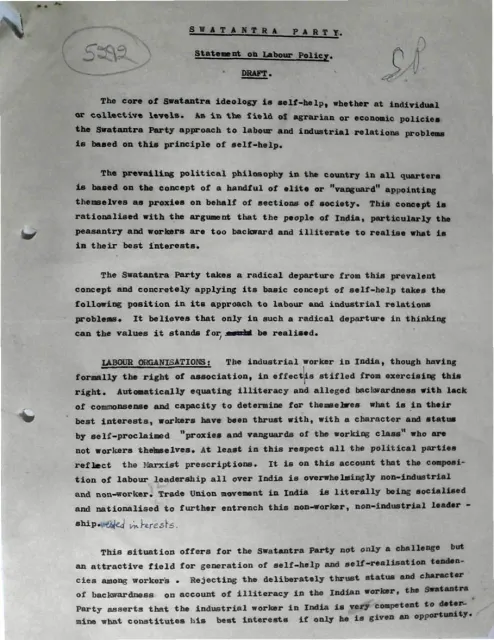
Summary
This four-page draft statement, issued by the Swatantra Party in Bombay and dated 5 October 1959, presents self-help as the core of the party’s labour policy. It rejects the idea that workers are too illiterate or backward to identify their own interests, arguing instead that industrial workers should control their own unions and should not be represented by non-worker political proxies. The statement opposes the domination of trade unions by political parties, including the Swatantra Party itself, while welcoming worker-members and worker-leaders into the party.
The statement criticises labour legislation for encouraging bureaucratic control, litigation, corruption, and barriers between labour, management, and government. It rejects compulsory industrial peace and proposed legal moratoria on strikes and lockouts, treating conflict as inevitable in a free society and advocating rational procedures and collective bargaining instead. The State’s role should be limited to providing services, maintaining a neutral position between labour and management, and intervening only where the public good is affected. The final section insists that labour and management have distinct identities and legitimate interests that cannot be merged, but can be reconciled through free collective bargaining between democratic, worker-controlled unions and management.
Key points
- Self-help is presented as the central principle of Swatantra labour and industrial-relations policy.
- Workers are described as capable of determining their own interests despite prevailing claims about illiteracy or backwardness.
- The statement favours worker-controlled, worker-conscious trade unions and rejects political-party control of unions.
- It calls for labour legislation that prevents non-workers from controlling unions and limits state interference in disputes.
- Industrial conflict is treated as inevitable in a free society rather than something to be suppressed through compulsory peace.
- The State should provide services and intervene neutrally only when the general public good is affected.
- Full collective bargaining should cover wages, working conditions, grievances, productivity, and workers’ fair share of profits.
- Labour and management are said to have separate identities and interests that should be reconciled through free negotiation rather than paternalism.
Metadata and summary are AI-extracted from the source PDF and reviewed for editorial accuracy. The original work is available via the Read PDF tab above (where present); paragraph-level citation inside the PDF is deferred to a future engagement.
Related across the archive
 Primary workLABOUR'S FRIEND— CONGRESS OR SWATANTRA?
 Primary workMinutes of the meeting of Trade Union Workers belonging to the Swatantra Party held in Bombay on July 28 and 29, 1962.
 Primary workStatement of Principles
 ExcerptStatement of the Principles of Swatantra Party
 ExcerptSocialism or State Capitalism