book
The following passages extracted from Lord Reith's autobiography Into The Wind.
6 pages
Summary
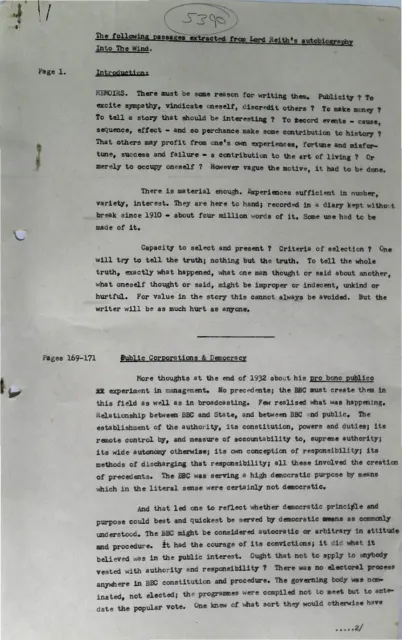
This six-page extract from Lord Reith’s autobiography Into The Wind presents three selected passages: an introduction to memoir-writing, reflections on the BBC and democratic government, and a short postscript. In the introduction, Reith considers why memoirs are written, describes the extensive diary material behind his account, and commits himself to telling the truth even when it may be improper, unkind, or hurtful.
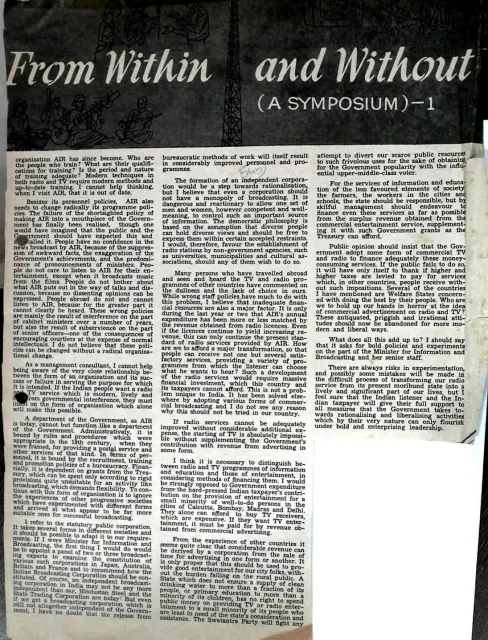
The central extract, headed “Public Corporations & Democracy,” uses the BBC’s institutional experience to question whether democratic purposes must always be pursued through conventional electoral mechanisms. Reith describes the BBC as autonomous and publicly accountable, yet governed by a nominated rather than elected body, and contrasts this arrangement with the timidity, compromise, and mediocrity he associates with electoral politics. He also links public-sector reform to nationalised rationalisation of coal mining and transport, criticises domestic social disorder, and expresses doubts about the League of Nations and the prospects for international stability. The postscript closes with a self-portrait of sustained, practical effort rather than conventional ambition.
Key points
- The introduction frames memoir-writing as a potentially historical and ethical act, not merely an exercise in publicity or self-justification.
- Reith says his memoir draws on a diary kept continuously since 1910, amounting to approximately four million words.
- He promises to tell the truth, including uncomfortable or potentially hurtful thoughts and events.
- The BBC is presented as a public corporation whose autonomy, accountability, and institutional procedures created precedents without following ordinary electoral democracy.
- The extract questions whether electoral mechanisms necessarily produce capable and responsible public leadership.
- Reith advocates nationalised rationalisation of troubled public services and basic industries, including coal mining and transport.
- The international discussion criticises ineffective compromise and asks whether Commonwealth and Empire could again contribute to global order.
- The postscript portrays the author as lacking conventional ambition but committed to doing whatever work came to hand as well and quickly as possible.
Metadata and summary are AI-extracted from the source PDF and reviewed for editorial accuracy. The original work is available via the Read PDF tab above (where present); paragraph-level citation inside the PDF is deferred to a future engagement.