
essay
From Within and Without
(A SYMPOSIUM)—1
THE ILLUSTRATED WEEKLY OF INDIA · 1965
2 pages
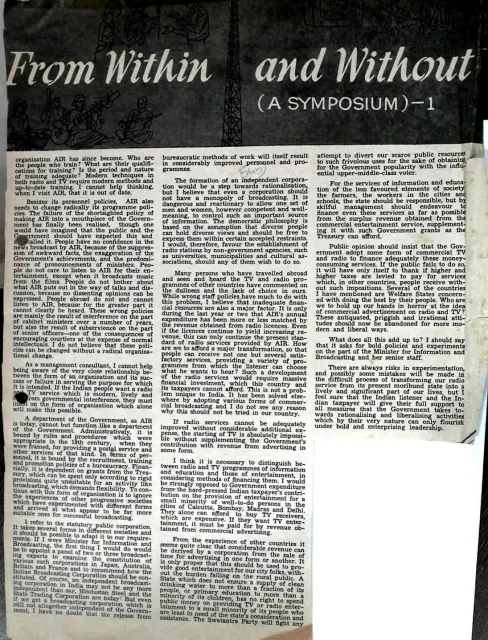
Summary
This continuation of the symposium article argues that All India Radio requires fundamental organisational and financial reform. The text criticises AIR’s bureaucratic structure, outdated recruitment and training practices, dependence on government grants, and susceptibility to ministerial and official interference. It proposes an independent public corporation, administered through a broader and less centralised structure involving universities, municipalities, and cultural associations, while preserving public provision of information and educational programming.
The article distinguishes informational and educational broadcasting from entertainment, arguing that entertainment should be financed primarily through commercial advertising rather than scarce public funds. It questions whether AIR’s expansion since Independence has produced better programming, noting weak audience engagement, limited impact on public opinion, inadequate regional reach, and an inability to cultivate talent. Drawing comparisons with the BBC, it calls for bold experimentation, professional autonomy, rationalisation, and leadership capable of transforming broadcasting into a more effective instrument of public communication.
Key points
- AIR is described as bureaucratic, politically influenced, and poorly adapted to modern broadcasting needs.
- The article advocates an independent public corporation rather than a government department or monopoly broadcaster.
- It recommends involving universities, municipalities, and cultural associations in the administration of radio services.
- AIR’s financial dependence on Treasury grants and licence revenue is presented as a major constraint.
- Entertainment programming is distinguished from information and education and is proposed for financing through commercial advertising.
- The article argues that quantitative expansion since Independence has not produced qualitative improvement in programmes or public influence.
- The BBC is used as a comparative model of professional purpose, institutional coherence, and effective broadcasting leadership.
Metadata and summary are AI-extracted from the source PDF and reviewed for editorial accuracy. The original work is available via the Read PDF tab above (where present); paragraph-level citation inside the PDF is deferred to a future engagement.
Related across the archive
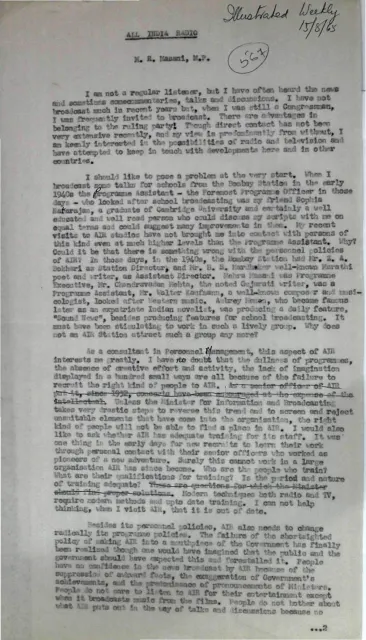 Primary workAll India Radio by Mr Minoo Masani
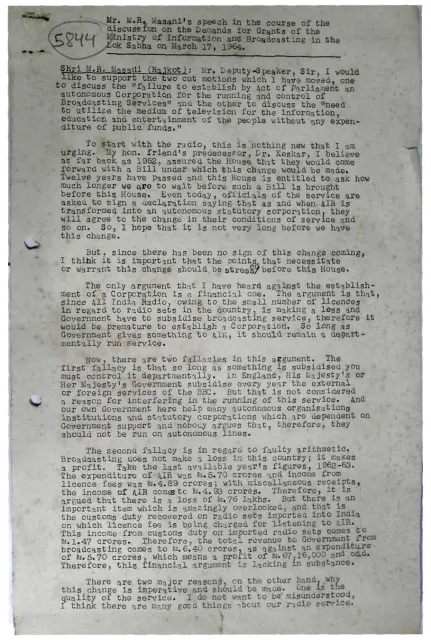 Primary workMr. M.R. Masani's speech in the course of the discussion on the Demands for Grants of the Ministry of Information and Broadcasting in the Lok Sabha on March 17, 1964.
 ExcerptManifesto for Indian Liberals
 ExcerptEconomic Reforms In India: Where Are We And Where Do We Go?