speech · parliamentary
Mr. M.R. Masani's speech in the course of the discussion on the Demands for Grants of the Ministry of Information and Broadcasting in the Lok Sabha on March 17, 1964.
By Minoo Masani
1964
7 pages
Summary
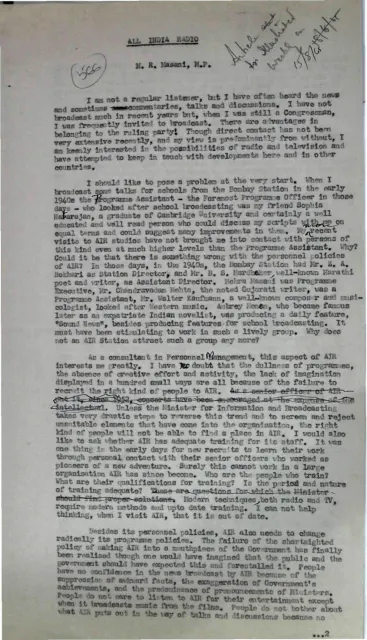
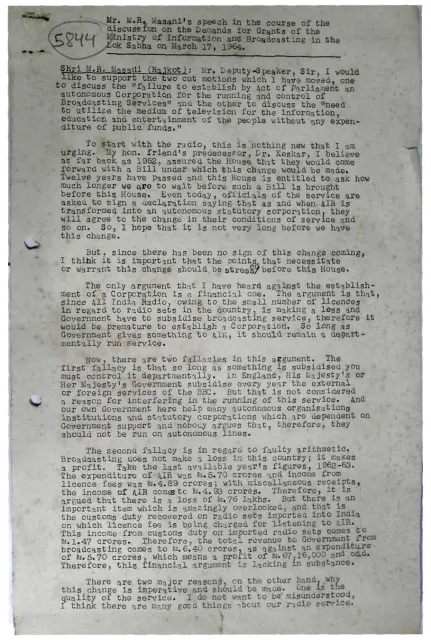
In this Lok Sabha speech of 17 March 1964, Minoo Masani argues that All India Radio should be converted into an autonomous statutory corporation rather than remain a departmental government service. He rejects the claim that subsidies justify departmental control, citing the 1962–63 figures to argue that broadcasting generated a substantial net profit once customs-duty receipts on imported radio sets were included. He also criticizes AIR for bureaucratic rigidity, limited responsiveness to public taste, repetitive programming, and susceptibility to political influence, while acknowledging that the service has many good features.
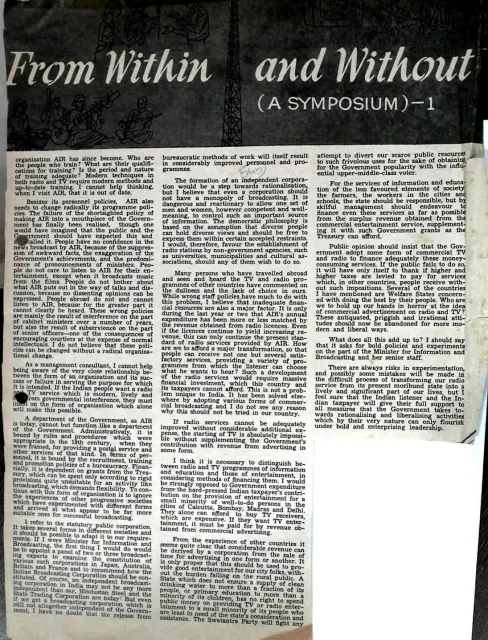
Masani then turns to television, urging the government to use it for information, education, and entertainment, especially in a largely illiterate country. Drawing on broadcasting models in Britain, Japan, the United States, and elsewhere, he recommends an autonomous system under parliamentary and governmental supervision, with competition and regulated sponsorship rather than monopoly or unrestricted commercial advertising. He presents television as capable of reaching rural and poorer audiences through community and institutional sets, and concludes by urging the minister to use his political authority to establish an independent, autonomous, and dignified broadcasting service.
Key points
- Masani supports creating an autonomous statutory corporation to run and control All India Radio.
- He disputes the financial case for keeping AIR under departmental government control and presents figures intended to show that broadcasting was profitable in 1962–63.
- He criticizes AIR’s lack of responsiveness, repetitive programming, official rigidity, and vulnerability to political interference.
- He compares possible Indian broadcasting arrangements with the BBC, the Independent Television Authority, American commercial broadcasting, and systems in Japan, Malaysia, Ghana, Nigeria, and Kenya.
- He argues that television has special importance for information, education, and entertainment in a largely illiterate country.
- He proposes regulated sponsorship as a way to finance television without placing the full burden on taxpayers.
- He urges parliamentary supervision without day-to-day political control and calls for a dignified, autonomous broadcasting service.
Metadata and summary are AI-extracted from the source PDF and reviewed for editorial accuracy. The original work is available via the Read PDF tab above (where present); paragraph-level citation inside the PDF is deferred to a future engagement.