Summary
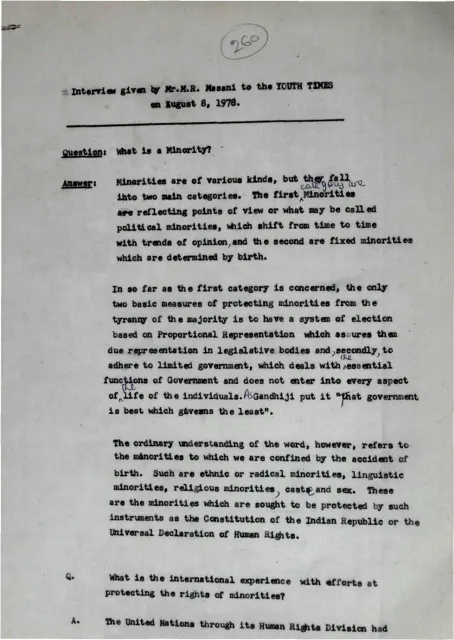
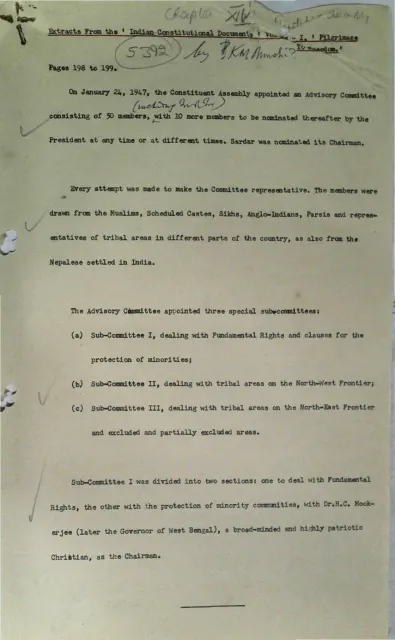
This extract, attributed to B. Shiva Rao, traces the Constituent Assembly’s work on minority safeguards and Fundamental Rights. The Advisory Committee, chaired by Sardar Vallabhbhai Patel, was designed to represent Muslims, Scheduled Castes, Sikhs, Anglo-Indians, Parsis, tribal communities, and Nepali settlers. Its subcommittees covered Fundamental Rights, minority protection, and tribal areas. The extract records the decision to abandon separate electorates, while retaining forms of political and administrative protection, including provisions for Anglo-Indian representation and special officers for minorities.
The later pages describe the Sub-Committee on Fundamental Rights and the disagreements within it over the scope and enforceability of rights. The members sought uniform Fundamental Rights for citizens and debated whether Directive Principles should be justiciable. K. T. Shah advocated an expansive programme including free education, public maintenance during illness and disability, abolition of proprietary rights, and enforceable Directive Principles, while others preferred to leave social policy to Parliament. The extract concludes with debate material on equality and titles, including the prohibition of titles from the Union and restrictions on accepting foreign honours.
Key points
- The Advisory Committee appointed in January 1947 was intended to include representatives of major religious, caste, tribal, and minority communities.
- Its three subcommittees addressed Fundamental Rights and minority protection, tribal areas on the North-West Frontier, and tribal or excluded areas in the North-East.
- The Committee accepted the recommendation to abolish separate electorates for minorities by an overwhelming majority.
- H. C. Mookerjee and Sir Homi Mody are presented as supporting a move away from specific minority reservations in the interest of national solidarity.
- The Fundamental Rights subcommittee pursued uniform rights for citizens and persons within the Union’s territory.
- The extract records disagreement over whether Directive Principles should be legally enforceable, distinguishing justiciable rights from non-justiciable principles.
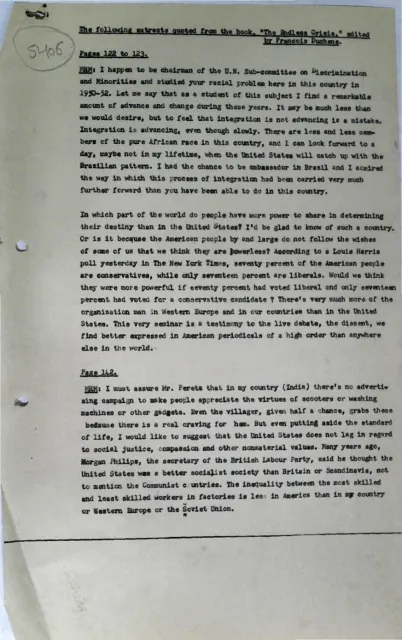
- The debate on equality proposed prohibiting titles conferred by the Union and limiting the acceptance of foreign titles, presents, and emoluments.
Metadata and summary are AI-extracted from the source PDF and reviewed for editorial accuracy. The original work is available via the Read PDF tab above (where present); paragraph-level citation inside the PDF is deferred to a future engagement.