reference · working paper
The Endless Crisis
21 pages
Summary
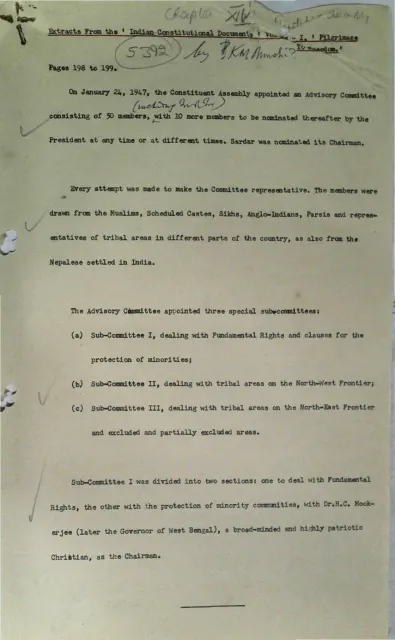
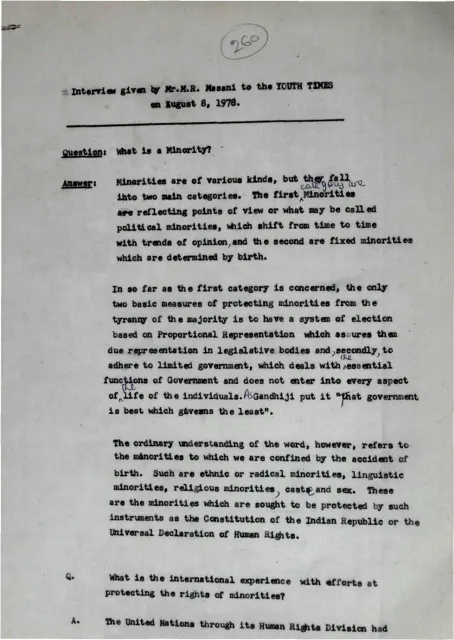
This untitled English-language reference packet assembles extracts and page references from Francois Duchene’s edited volume “The Endless Crisis” and B. Shiva Rao’s “The Framing of India’s Constitution.” The visible material first contrasts racial integration and political participation in the United States, then turns to the Constituent Assembly’s Advisory Committee and Fundamental Rights Sub-Committee in 1947. It records debates over justiciable and non-justiciable rights, religious institutions, the use of Roman script alongside Devanagari and Persian, forced labour and compulsory military service, and the possibility of a common civil code and interfaith marriage.
The later pages reproduce or summarize dissenting minutes by M. R. Masani, Hansa Mehta, and Amrit Kaur. These dissenters argue for Roman-script access to the national language, a time-bound uniform civil code, and constitutional protection for marriages between citizens regardless of religion. The packet also follows disputes over minority representation, proportional or cumulative voting, the position of the Parsi community, the allocation of planning among Union subjects, and an argument between Masani and Jawaharlal Nehru over planning. The packet’s own compiler, date, issuer, and formal title are not visible; one PDF page is also missing from the rendered set.
Key points
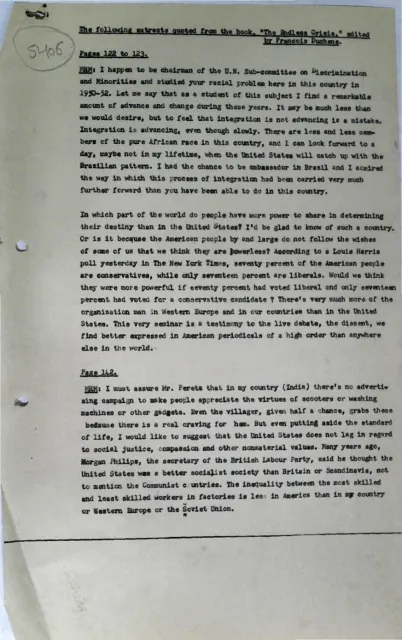
- The packet juxtaposes an extract on racial integration and political participation in the United States with documentary notes on India’s constitutional drafting.
- The Fundamental Rights Sub-Committee divided rights into justiciable rights enforceable through legal action and non-justiciable rights intended as general guidance for the State.
- M. R. Masani advocated an independent judicial authority, enforceable fundamental rights, and recognition of group rights as well as individual rights.
- The extracts record disagreements over Roman script, religious institutions, forced labour, compulsory military service, a common civil code, and interfaith marriage.
- Masani, Hansa Mehta, and Amrit Kaur’s dissenting minutes supported a uniform civil code within five or ten years and constitutional protection against religious impediments to marriage.
- The packet describes debates over minority representation, including a rejected proposal for proportional representation and the adoption of reservations for recognized minorities.
- The Union Powers Committee material includes planning among subjects proposed for inclusion in the Union List and notes a disagreement between Masani and Nehru over its allocation.
Metadata and summary are AI-extracted from the source PDF and reviewed for editorial accuracy. The original work is available via the Read PDF tab above (where present); paragraph-level citation inside the PDF is deferred to a future engagement.