pamphlet
THE ELECTORAL SYSTEM AND THE NEED FOR REFORM
40 pages
Summary
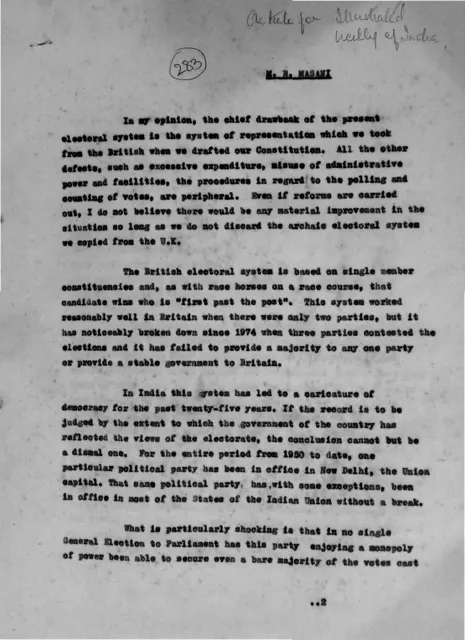
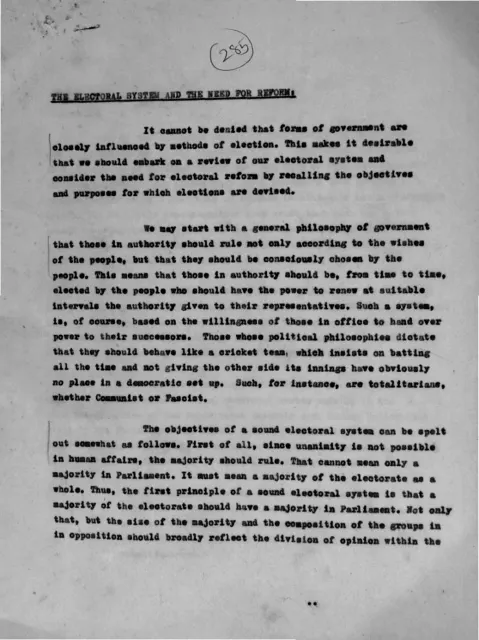
In the rendered pages, the pamphlet argues that India’s electoral system should be judged by whether it produces government that reflects the electorate, gives votes roughly equal weight, ensures effective representation, and preserves a reasonable balance between government and opposition. It criticises the British-style first-past-the-post system for converting minority electoral support into large parliamentary majorities, wasting many votes, weakening opposition, and enabling prolonged one-party dominance. The discussion links electoral design to constitutional safeguards, corruption, administrative efficiency, and the protection of fundamental rights.
In the rendered pages, the author recounts the Constituent Assembly debate in 1947, where a proposal for proportional representation—preferably through cumulative voting in multi-member constituencies—was rejected in favour of a decisive-majority, two-party model associated with Sardar Vallabhbhai Patel. The pamphlet then examines proportional representation, cumulative voting, list systems, the second ballot, and a mixed West German-style system. It favours a mixed arrangement capable of retaining a constituency link while more fairly reflecting public opinion, and it also calls for an independent Election Commission, caretaker-government restrictions during elections, regulation of campaign finance, and safeguards against misuse of state-controlled broadcasting. The rendered pages end during the discussion of company donations to political parties; later pages were not available.
Key points
- A sound electoral system should give the electorate’s majority an effective parliamentary majority while fairly representing minority views.
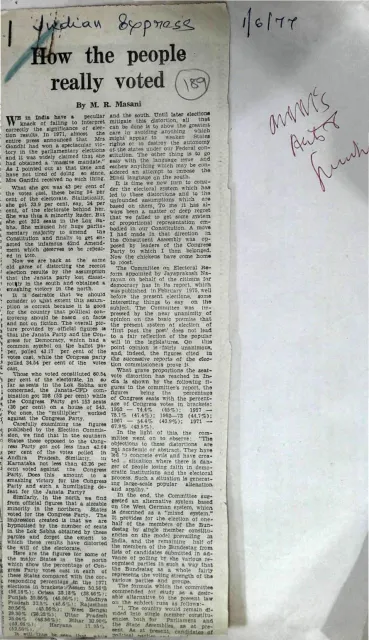
- The first-past-the-post system is presented as producing severe distortions between votes received and seats won.
- The author recounts opposing reserved seats and advocating proportional representation and cumulative voting in the Constituent Assembly.
- Cumulative voting, list systems, and the second ballot are assessed as alternatives suited to Indian conditions.
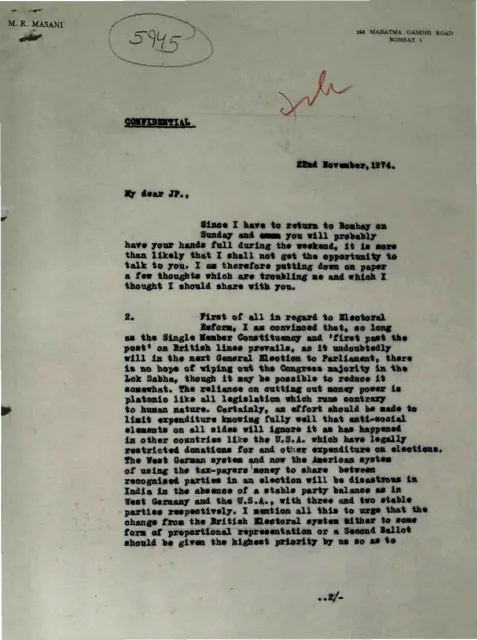
- A mixed electoral system modeled on West Germany is presented as a way to combine constituency representation with proportionality.
- The pamphlet connects electoral distortion with one-party dominance, wasted votes, corruption, weak opposition, and threats to constitutional rights.
- The visible reform agenda includes a more independent Election Commission, caretaker-government rules, limits on official campaigning, and transparent political-finance accounting.
Metadata and summary are AI-extracted from the source PDF and reviewed for editorial accuracy. The original work is available via the Read PDF tab above (where present); paragraph-level citation inside the PDF is deferred to a future engagement.