Summary
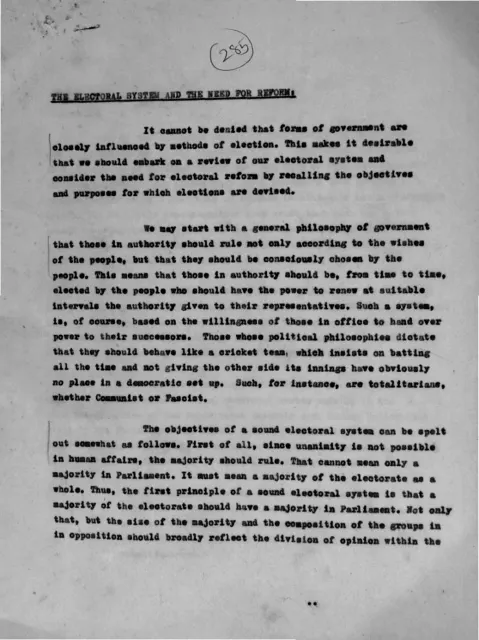
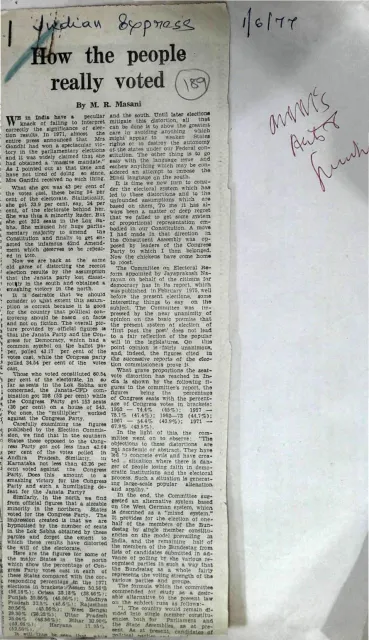
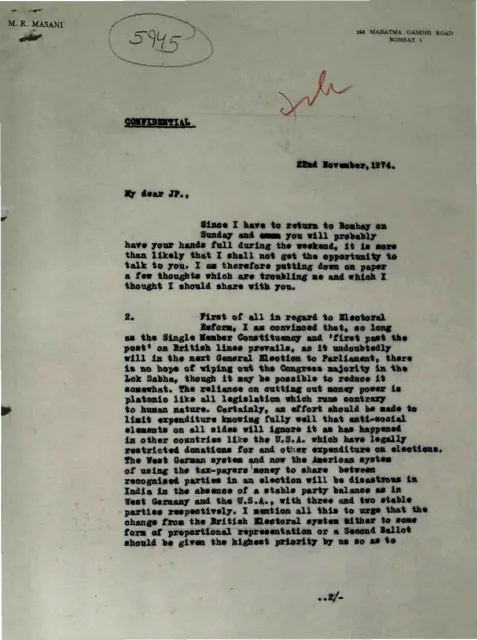
In this confidential letter dated 22 November 1974, M. R. Masani writes to Jayaprakash Narayan about electoral strategy, opposition unity, and the constitutional balance between Bihar and the national political arena. He argues that the existing British-style first-past-the-post system will probably preserve the Congress majority in the Lok Sabha and recommends giving highest priority to proportional representation or a second-ballot system. He also urges restrictions on election spending, warning that reliance on money power is “plutocratic” and that public opinion must be educated to the realities of electoral politics.
Masani is skeptical of the effort to create a national electoral bloc against the ruling party, recalling the earlier failure of Rajaji’s and his own initiative because of sabotage and double-crossing among opposition leaders. He warns Narayan that an effort to impose a “one against one” contest in every constituency will produce disputes over seat-sharing and may entangle him in conflicts among supposedly cooperating parties. As an alternative, he proposes that Narayan concentrate on Bihar, potentially sustaining a parallel government and preparing for state and parliamentary elections in March 1976, while allowing other opposition groups to take the lead outside Bihar. The letter closes by offering to discuss these questions in Delhi or Patna and to consult Narayan about a short book Masani is writing on him and his movement.
Key points
- Masani predicts that first-past-the-post voting will preserve the Congress majority in the Lok Sabha.
- He advocates proportional representation or a second-ballot system as an urgent electoral reform.
- He calls for limits on election expenditure and public education about the realities of electoral finance.
- He doubts that opposition parties can sustain a national electoral bloc because of factionalism and competing interests.
- He questions the feasibility of a “one against one” opposition strategy in every constituency.
- He recommends that Narayan focus primarily on Bihar and consider a parallel government there.
- He links the Bihar strategy to restoring federal constitutional autonomy and resisting central overreach.
Metadata and summary are AI-extracted from the source PDF and reviewed for editorial accuracy. The original work is available via the Read PDF tab above (where present); paragraph-level citation inside the PDF is deferred to a future engagement.