Summary
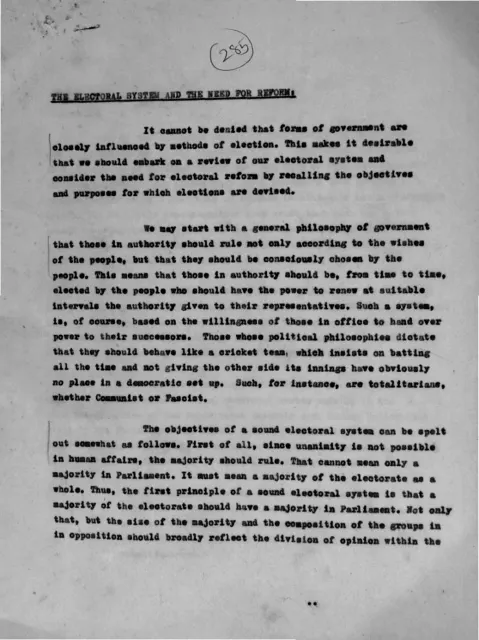
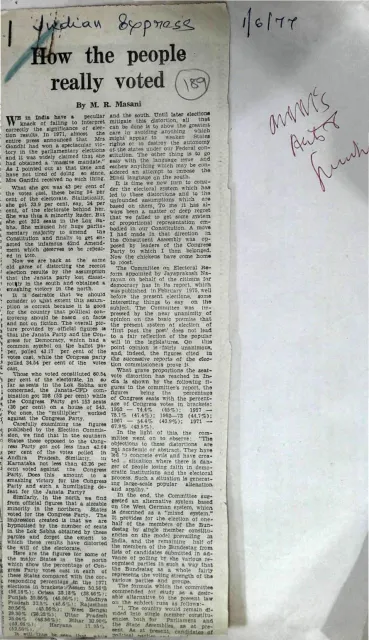
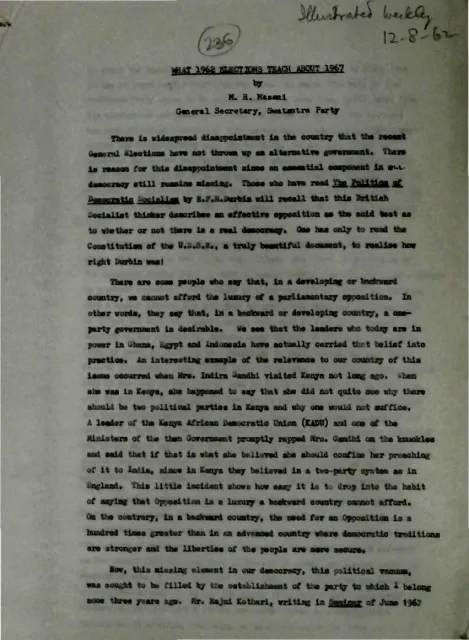
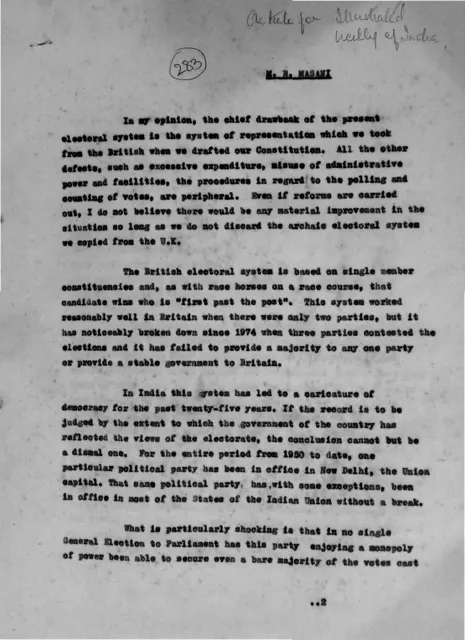
In this five-page essay, M. R. Masani identifies India’s adoption of the British single-member, first-past-the-post electoral system as the chief defect in the country’s constitutional arrangements. He argues that administrative failures, excessive expenditure, misuse of power, and flaws in polling and vote-counting are secondary so long as the basic electoral system remains unchanged. In his view, the system has allowed the Congress Party to exercise prolonged political dominance despite securing only a minority of the votes, thereby distorting popular representation and facilitating constitutional changes that weakened fundamental rights, the President’s veto power, and judicial independence.
Masani rejects the claim that plurality elections would produce a stable two-party system, noting that India’s experience has instead preserved a large number of parties while wasting millions of votes. He advocates a mixed electoral system combining single-member constituencies with proportional representation through party lists, drawing on the Federal Republic of Germany as an example. He presents this arrangement as a way to correct distortions in the popular vote while retaining links between legislators and constituencies, and calls for a public campaign to educate citizens and legislators about electoral reform.
Key points
- Masani treats the inherited British electoral system, rather than ancillary election procedures, as the central institutional defect.
- He argues that first-past-the-post has enabled Congress governments to win large parliamentary majorities without majority electoral support.
- The essay links electoral distortion to the weakening of fundamental rights, presidential veto power, and judicial independence.
- Masani disputes the idea that single-member plurality elections reduce the number of political parties or create a stable two-party system.
- He recommends a mixed system combining constituency seats with proportional representation through party lists.
- The German model is presented as a means of combining representative proportionality, constituency accountability, stable parties, and independent candidates.
- The essay concludes by stressing the need for public education and a campaign for electoral reform.
Metadata and summary are AI-extracted from the source PDF and reviewed for editorial accuracy. The original work is available via the Read PDF tab above (where present); paragraph-level citation inside the PDF is deferred to a future engagement.