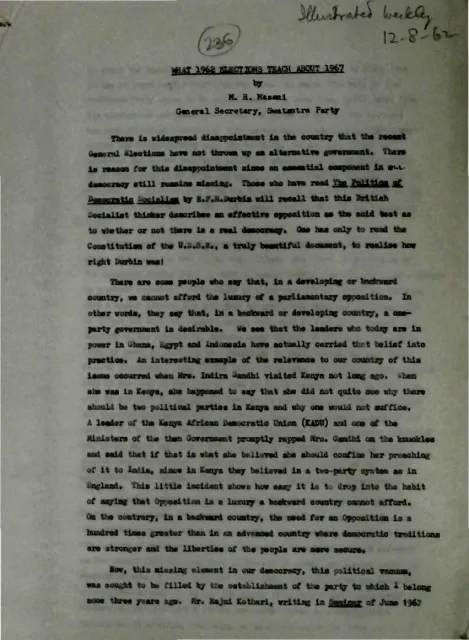
Summary
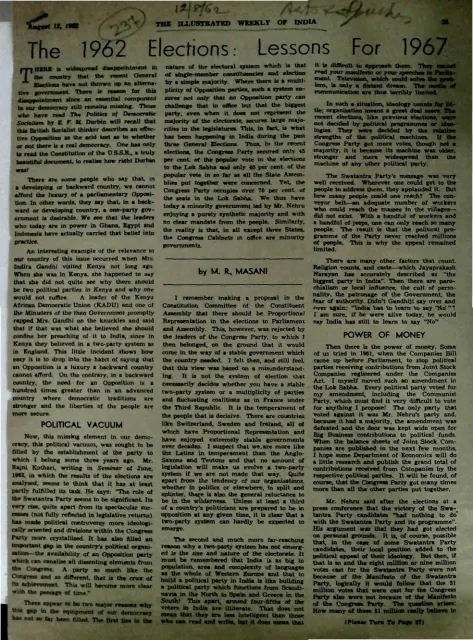
In the rendered pages, M. R. Masani argues that the 1962 elections revealed a central weakness in Indian democracy: the absence of an effective parliamentary opposition. He rejects the claim that developing countries cannot afford opposition parties, arguing instead that opposition is more necessary where democratic traditions and civil liberties are less secure. He presents the Swatantra Party as having begun to fill the political gap left by Congress dominance, while acknowledging that its electoral success was not fully reflected in legislative representation.
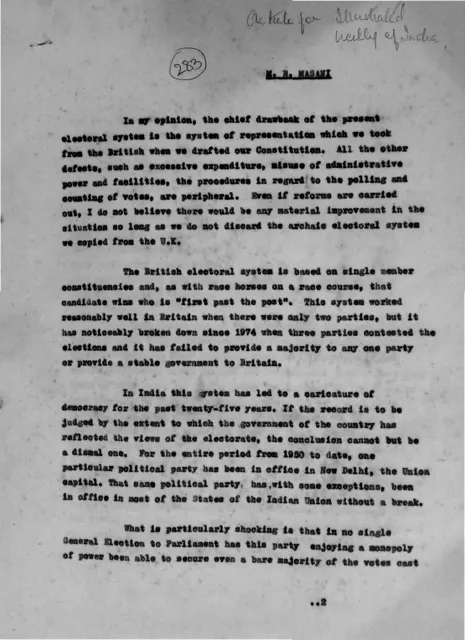
In the rendered pages, Masani attributes the failure to produce a stable two-party system to both the electoral system and the scale and diversity of the Indian electorate. Single-member constituencies and plurality voting allow Congress to win large legislative majorities without majority popular support; he contrasts this with proportional-representation systems in Switzerland, Sweden, and Ireland. He also stresses illiteracy, limited communications, caste, religion, local influence, personality, patronage, and the power of incumbency. The essay concludes, in the rendered pages, with practical proposals for building an effective opposition: early candidate selection, integrity and competence in candidates, disciplined grassroots organisation, broad social representation, internal discipline, transparent finances, and political education. Masani treats democratic success as dependent on moral confidence, competent management, and the willingness of parties to serve the public rather than themselves.
Key points
- The 1962 elections exposed the absence of an effective parliamentary opposition despite continuing democratic institutions.
- Masani defends opposition as especially necessary in a developing country, where democratic traditions and liberties are less secure.
- He argues that plurality voting in single-member constituencies gives Congress disproportionate legislative power relative to its popular vote.
- Proportional representation is presented as compatible with stable government, with Switzerland, Sweden, and Ireland offered as examples.
- India’s size, linguistic diversity, illiteracy, weak communications, caste, religion, local influence, and patronage limit ideological voting and national party organisation.
- The Swatantra Party’s future success, in Masani’s account, depends on candidate quality, early nominations, grassroots organisation, broad social inclusion, discipline, and clean finances.
- Masani argues that democratic parties must educate voters and build faith in citizens’ intelligence rather than rely on cynicism or patronage.
Metadata and summary are AI-extracted from the source PDF and reviewed for editorial accuracy. The original work is available via the Read PDF tab above (where present); paragraph-level citation inside the PDF is deferred to a future engagement.