speech · memorial lecture
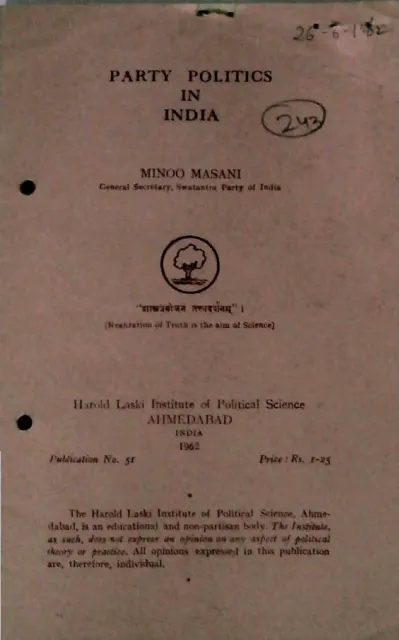
PARTY POLITICS IN INDIA
By Minoo Masani
Harold Laski Institute of Political Science, Ahmedabad, India · AHMEDABAD · 1962
15 pages
Summary
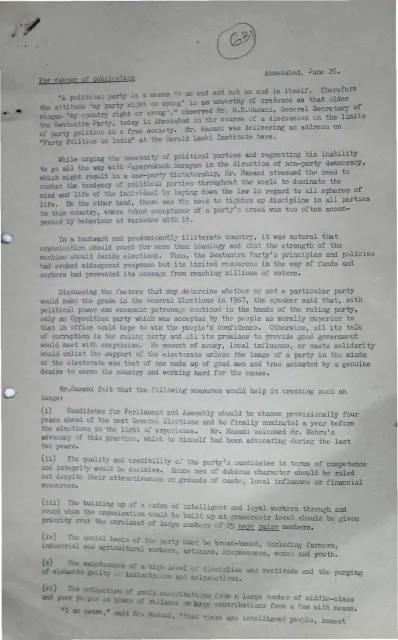
In this 1962 memorial lecture, delivered at the Harold Laski Institute, Minoo Masani examines the place of political parties in Indian democracy through the experience and programme of the Swatantra Party. He argues that parties are necessary because they help voters choose among competing programmes and representatives, but warns that parties must not become ideological machines that dictate every aspect of their members’ thought and conduct. A democratic party, in his account, requires an effective opposition, freedom of expression within the party, and a clear limitation on the party’s sphere of authority.
Masani then turns to India’s institutional problems. He criticises the first-past-the-post electoral system for allowing a party to form a government without majority support in the electorate, and advocates electoral reform while acknowledging that no electoral formula can overcome differences in national political temperament. He rejects the simplistic labels “Left” and “Right,” presenting the Swatantra Party instead as liberal and partly Gandhian: committed to minimum government, maximum individual liberty, free economic choice, and safeguards against concentrated power. The lecture’s final sections stress the practical conditions of opposition-party success—candidate quality, advance selection, grassroots organisation, internal discipline, broad social representation, financial accountability, and moral credibility—and conclude that party loyalty must remain subordinate to conscience. The rendered pages include the complete 22-page lecture text, together with front and back matter.
Key points
- Political parties are presented as necessary instruments for enabling voters to choose representatives with shared programmes or principles.
- Masani argues that democracy requires an effective opposition capable of becoming an alternative government.
- He criticises India’s single-member, simple-majority electoral system for producing governments without majority popular support.
- He cautions against importing the labels “Left” and “Right” into political contexts where they obscure rather than clarify programmes.
- The Swatantra Party is described as liberal and Gandhian, favouring minimum government, maximum individual liberty, and competitive enterprise.
- Masani contends that party organisation, communication, caste and religious identities, local influence, and money often matter more electorally than ideology.
- He proposes advance candidate selection, credible and competent nominees, grassroots workers, broad social representation, discipline, and transparent finances.
- The lecture closes by insisting that parties are means to democratic ends and that loyalty to a party must not override individual conscience.
Metadata and summary are AI-extracted from the source PDF and reviewed for editorial accuracy. The original work is available via the Read PDF tab above (where present); paragraph-level citation inside the PDF is deferred to a future engagement.