lecture
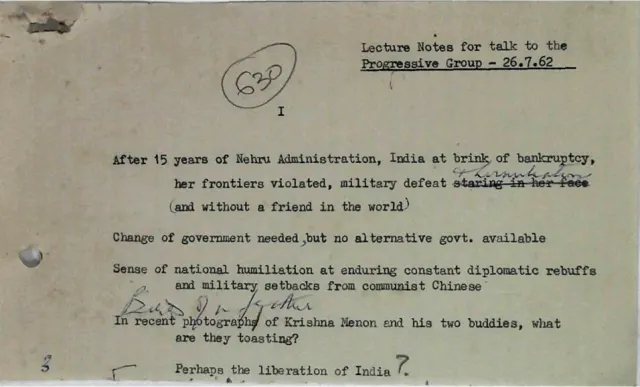
Lecture Notes for talk to the Progressive Group
1962
15 pages
Summary
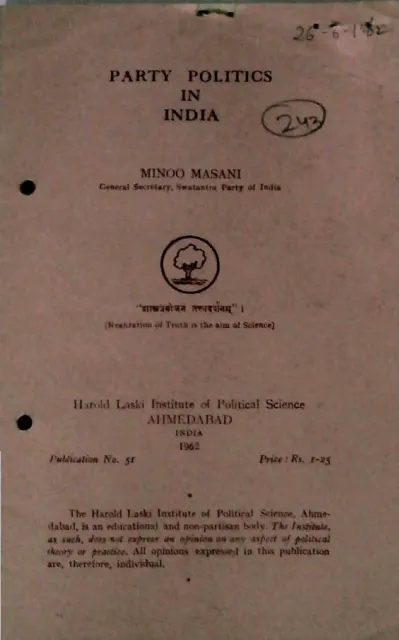
These typed lecture notes, dated 1962, argue for the necessity of an organised party system and a strong opposition in Indian democracy. The notes present the Swatantra Party as a distinctive alternative to Congress and communism: a party committed to internal freedom of expression, individual liberty, limited government, and an independent relationship with students, trade unions, municipalities, and panchayats. The document criticises non-party democracy as a danger that could produce one-party rule, and treats the absence of an effective opposition as a political vacuum.
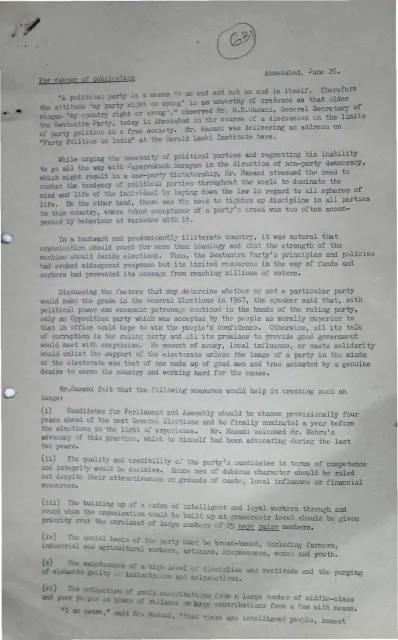
The notes also develop an ideological defence of Swatantra against the labels “right,” “reactionary,” and “conservative.” They argue that such categories have lost their meaning and that the party is more accurately described as liberal and Gandhian, combining minimum government with maximum individual freedom. The final sections turn from doctrine to political organisation: the party must communicate with a largely illiterate electorate, select candidates well in advance, build a disciplined grassroots cadre, reject caste and personal influence as substitutes for political quality, broaden its social base, and finance itself through many small contributions. The supplied file is composite or misfiled: its first page is headed “Lecture Notes for talk to the Progressive Group - 26.7.62,” while pages 2–15 are headed as notes for a 26 June 1962 talk on “Party Politics in India” at the Harold Laski Institute of Political Science, Ahmedabad.
Transcript
Summary
These typed lecture notes, dated 1962, argue for the necessity of an organised party system and a strong opposition in Indian democracy. The notes present the Swatantra Party as a distinctive alternative to Congress and communism: a party committed to internal freedom of expression, individual liberty, limited government, and an independent relationship with students, trade unions, municipalities, and panchayats. The document criticises non-party democracy as a danger that could produce one-party rule, and treats the absence of an effective opposition as a political vacuum.
The notes also develop an ideological defence of Swatantra against the labels “right,” “reactionary,” and “conservative.” They argue that such categories have lost their meaning and that the party is more accurately described as liberal and Gandhian, combining minimum government with maximum individual freedom. The final sections turn from doctrine to political organisation: the party must communicate with a largely illiterate electorate, select candidates well in advance, build a disciplined grassroots cadre, reject caste and personal influence as substitutes for political quality, broaden its social base, and finance itself through many small contributions. The supplied file is composite or misfiled: its first page is headed “Lecture Notes for talk to the Progressive Group - 26.7.62,” while pages 2–15 are headed as notes for a 26 June 1962 talk on “Party Politics in India” at the Harold Laski Institute of Political Science, Ahmedabad.
Key points
- The notes present political parties as essential institutions of democracy and warn that non-party democracy may become one-party rule.
- The Swatantra Party is described as an opposition capable of channelling dissent from Congress while permitting internal freedom of expression.
- The party’s stated position on students and trade unions favours political independence within educational and worker organisations.
- The notes defend a liberal and Gandhian programme of minimum government, individual freedom, and resistance to excessive state power.
- They reject the conventional left-right vocabulary as historically contingent and politically misleading.
- The practical discussion stresses candidate quality, early nominations, grassroots organisation, party discipline, a broad social base, and small-donor funding.
- The notes identify illiteracy, weak communications, caste, religion, patronage, money, and personality politics as obstacles to a functioning party system.
Metadata and summary are AI-extracted from the source PDF and reviewed for editorial accuracy. The original work is available via the Read PDF tab above (where present); paragraph-level citation inside the PDF is deferred to a future engagement.