Summary
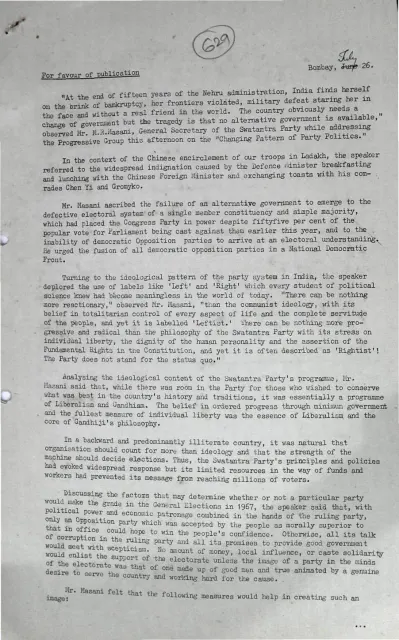
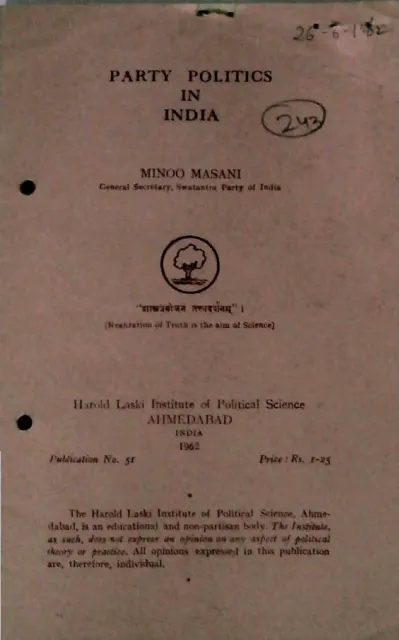
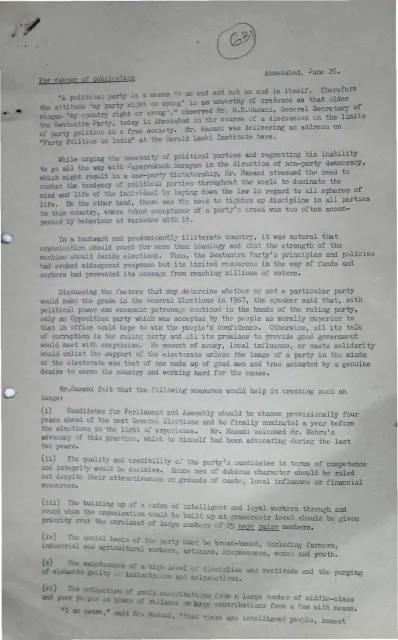
In this two-page press note, M. R. Masani reports on his Ahmedabad address, “Party Politics in India,” delivered at the Harold Laski Institute on the limits of party politics in a free society. He argues that political parties are instruments rather than ends in themselves, rejects unquestioning party loyalty, and warns that parties can impose control over the individual. Although he regrets not following Jayaprakash Narayan all the way toward non-party democracy, he maintains that political parties remain necessary and calls for greater discipline within them.
Masani presents the Swatantra Party as a liberal and Gandhian alternative to both Congress dominance and communist totalitarianism. He links its prospects in the 1967 general elections to credible candidates, an intelligent and loyal cadre, a broad social base, strict internal discipline, and small contributions from ordinary supporters rather than dependence on wealthy donors. He also identifies the absence of an effective opposition as a central weakness of Indian democracy, criticizes the distortions produced by the electoral system and inflated legislative majorities, and advocates electoral adjustments including the list system or alternative voting. The document does not identify its publication venue or year.
Key points
- Masani distinguishes a political party’s practical purpose from ideological or partisan loyalty for its own sake.
- He argues that parties must be restrained from controlling every sphere of individual life while also maintaining internal discipline.
- The Swatantra Party’s limited funds and shortage of workers are presented as barriers to reaching millions of voters.
- Masani attributes electoral success to candidate credibility, organizational depth, social breadth, discipline, and broad-based small contributions.
- He characterizes the Swatantra programme as combining liberalism, Gandhian principles, minimum government, and maximum individual liberty.
- He rejects the conventional labels “Left” and “Right,” arguing that Swatantra’s emphasis on liberty and constitutional rights is wrongly called “Rightist.”
- The note identifies the lack of an effective opposition and the distortions of India’s electoral system as major democratic problems.
- Masani calls for electoral reform and cooperation among opposition parties to avoid contests that divide the anti-government vote.
Metadata and summary are AI-extracted from the source PDF and reviewed for editorial accuracy. The original work is available via the Read PDF tab above (where present); paragraph-level citation inside the PDF is deferred to a future engagement.