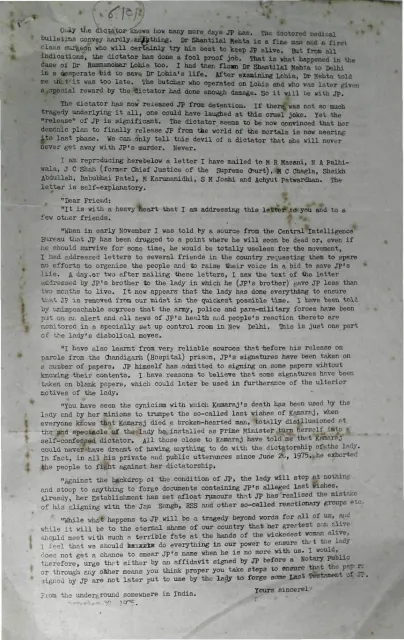
press clipping
INDIAN SOCIALIST PLOT TO FORM SECRET BODY
Revelation In Papers Seized from Jayaprakash Narain
Extracted from The Times Of India, October 17, 1941 · 1941
10 pages
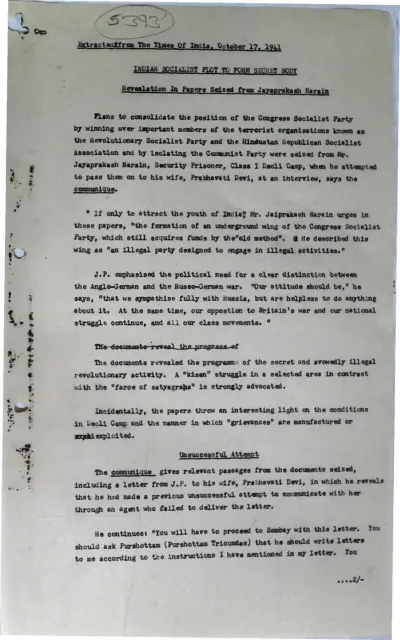
Summary
This six-page extract from The Times of India, dated October 17, 1941, reproduces and comments on papers attributed to Jayaprakash Narain while he was detained at Deoli Camp. The report presents Narain as advocating the consolidation of the Congress Socialist Party through relationships with the Revolutionary Socialist Party and the Hindustan Republican Socialist Association, while isolating the Communist Party. It describes plans for an underground and avowedly illegal wing, recruitment and funding through clandestine methods, and a selected-area “kisan” struggle as an alternative to what the report calls the “farce of satyagraha.”
The extract also publishes instructions for covert communication with Prabhavati Devi, including coded references and the concealment of letters in book bindings. A substantial section addresses the Congress Socialist Party’s position on the Second World War: Narain distinguishes the Anglo-German war from the Russo-German war, expresses sympathy with Russia, and maintains opposition to Britain’s war effort and to imperialism. The closing commentary questions whether the seized documents are genuine and argues that their publication may be intended to persuade Congress leaders that non-violence could conceal illegal activity, while also warning legislators that apparently genuine prison grievances might be exploited as political devices.
Key points
- The extract reports alleged plans to strengthen the Congress Socialist Party by incorporating the Revolutionary Socialist Party and isolating the Communist Party.
- It describes a proposed underground wing operating under an illegal name and using clandestine fundraising and recruitment.
- The reproduced papers contain detailed instructions for passing letters through book bindings and using an apparently innocent statement as a delivery code.
- Narain urges a distinction between the Anglo-German and Russo-German wars, combining sympathy for Russia with continued opposition to Britain’s war and imperialism.
- The extract contrasts selected-area peasant action with satyagraha and advocates a more independent and spectacular political line.
- The newspaper commentary questions the authenticity and political purpose of the documents and suggests that their publication targets Gandhi and the Congress High Command.
- The final section argues that prison and detention-camp grievances may be manufactured or exploited as political stunts, potentially misleading well-intentioned legislators.
Metadata and summary are AI-extracted from the source PDF and reviewed for editorial accuracy. The original work is available via the Read PDF tab above (where present); paragraph-level citation inside the PDF is deferred to a future engagement.