edited volume · collected works
Extracts from Sardar Patel's Correspondence, 1945-50, Volume 2
1945
7 pages
Summary
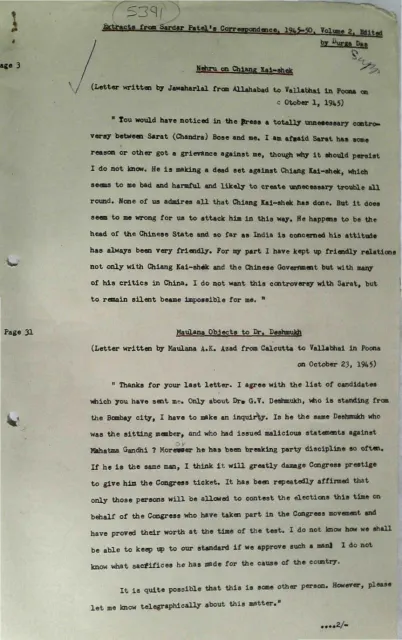
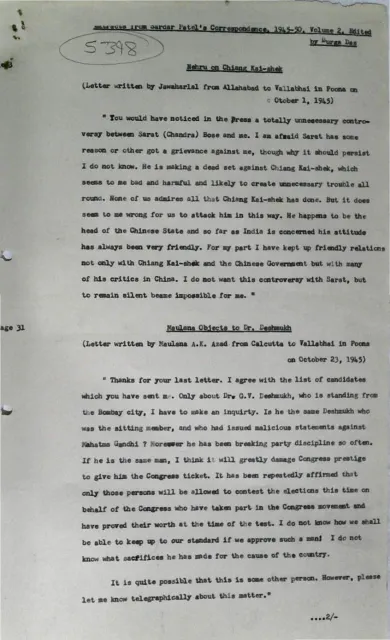
The rendered extract from Extracts from Sardar Patel’s Correspondence, 1945-50, Volume 2, edited by Durga Das, brings together correspondence from October to December 1945 concerning Congress organisation, candidate selection, and relations with major political figures. Jawaharlal Nehru objects to Sarat Chandra Bose’s public criticism of Chiang Kai-shek, while Maulana A.K. Azad questions the Congress candidacy of Dr. G.V. Deshmukh on grounds of alleged indiscipline and earlier criticism of Mahatma Gandhi.
The remaining rendered letters focus on the selection of Congress candidates for the Central and Provincial Assemblies. Vallabhbhai Patel discusses competing claims for the Central Assembly leadership, the candidacies of Asaf Ali, Sarat Bose, Professor K.T. Shah, Dr. Jivraj Mehta, Dr. Deshmukh, and M.R. Masani, and the practical importance of regional and community representation in Bombay. The correspondence also addresses campaign finance and the expectation that Congress candidates and organisers should maintain the party’s prestige. The pages shown are selected extracts from a larger correspondence volume rather than a complete formal contents sequence.
Key points
- Nehru defends maintaining friendly relations with Chiang Kai-shek and the Chinese Government despite disagreements with Chiang’s critics.
- Azad questions whether Dr. G.V. Deshmukh’s record of alleged indiscipline and criticism of Gandhi is compatible with a Congress candidacy.
- Patel describes a dispute over leadership of the Central Assembly party involving Sarat Bose and Asaf Ali, warning that outside pressure could provoke party trouble.
- The correspondence evaluates candidates partly through ability, nationalist commitment, prior Congress service, regional representation, and community balance.
- Patel and his correspondents debate whether Bombay’s representation should include Maharashtrian, Gujarati, and Parsi candidates.
- Patel ultimately defends selecting Deshmukh as a practical electoral choice despite acknowledged faults.
- The final letters address campaign expenses, Congress financing, and the obligation to protect the party’s prestige.
Metadata and summary are AI-extracted from the source PDF and reviewed for editorial accuracy. The original work is available via the Read PDF tab above (where present); paragraph-level citation inside the PDF is deferred to a future engagement.