Summary
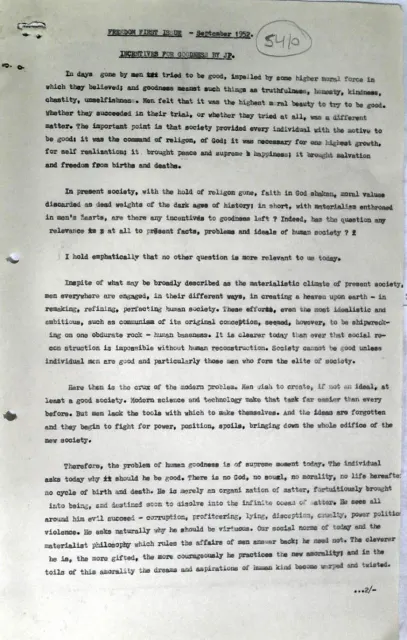
In “Incentives for Goodness,” Jayaprakash Narayan asks how goodness can be sustained in a modern society where religious faith has weakened and materialism has become dominant. He argues that social reconstruction cannot succeed without the moral reconstruction of individuals, especially the elites who shape society. Scientific and technological progress may make it easier to build institutions, but it cannot supply the inner discipline or ethical purpose required to prevent struggles for power, privilege, and spoils from destroying them.
Narayan directly challenges dialectical materialism and other materialist philosophies, arguing that they provide no rational incentive for deliberate goodness. He does not claim that materialists are necessarily vicious or that all non-materialists are good; rather, he maintains that goodness requires going beyond matter and referring the individual to an objective purpose outside the self. Human beings are described as socio-organic, acquiring their moral character through social conditioning, while the conduct of elites determines the direction and fate of society. The visible article ends by presenting transcendence of materialism as the condition for the individual to become an end in himself.
Key points
- The article contrasts earlier religiously grounded incentives to goodness with the moral uncertainty of a materialist society.
- Narayan argues that social reconstruction is impossible without the reconstruction of individual character.
- Modern science and technology cannot by themselves provide the moral tools needed to create a good society.
- Dialectical materialism and materialism generally are presented as unable to justify deliberate goodness.
- Human moral character is shaped partly by nature and partly by social conditioning.
- Ordinarily decent people may become violent when exposed to destabilising social pressures.
- The philosophy and conduct of elites are more important to social direction than the character of the inner mass.
- Narayan defines non-materialism as rejecting matter as ultimate reality and orienting the individual toward an objective purpose.
Metadata and summary are AI-extracted from the source PDF and reviewed for editorial accuracy. The original work is available via the Read PDF tab above (where present); paragraph-level citation inside the PDF is deferred to a future engagement.