periodical issue
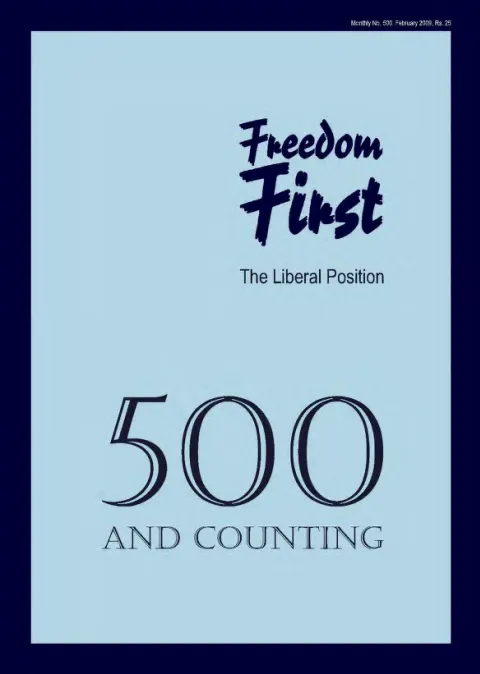
Freedom First
The Liberal Position
By Minoo Masani, Jayaprakash Narayan, Arvind Deshpande, S. V. Raju, Sharad Bailur, S. P. Sathe
Publishers: Indian Committee for Cultural Freedom (ICCF), 3rd Floor, Army & Navy Building, 148, Mahatma Gandhi Road, Mumbai 400 001 · Mumbai · 2009
156 pages
Freedom First
Summary
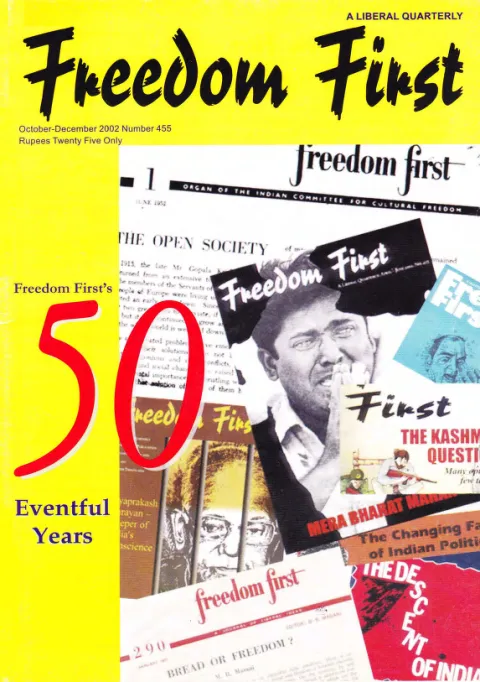
In the rendered pages, Freedom First’s 500th issue presents itself as a commemorative anthology marking fifty-six years of publication, dedicated to readers and supporters by the Indian Committee for Cultural Freedom. In the rendered pages, the editorial material explains that the issue distils no more than forty articles from the magazine’s history, notes the six-month suspension during the 1975 Emergency, and frames Freedom First as a liberal journal committed to cultural freedom, open debate, secular values, free enterprise, and resistance to totalitarianism.
In the rendered pages, the contents and first articles show the issue moving chronologically through Freedom First’s recurring concerns: the open society, press freedom, anti-communism, fundamental liberties, dissent, democracy, and the moral foundations of social reform. In the rendered pages, the first complete selections include the inaugural 1952 statement on the open society, Minoo Masani’s 1972 rededication during a period of constitutional and press-freedom anxiety, a 1956 defence of the Indian Committee for Cultural Freedom and Democratic Research Service against Jawaharlal Nehru’s criticism, R. A. Jahagirdar’s 2009 tribute to John Stuart Mill’s On Liberty, and Jayaprakash Narayan’s 1952 argument that social reconstruction requires moral reconstruction.
Key points
-
The 500th-issue editorial dedicates the anthology to readers and supporters, explaining that fewer than forty articles were selected from fifty-six years of publication, spanning the magazine’s June 1952 founding to 2009, with a six-month gap during the 1975 Emergency.
-
“The Evolution of Freedom First” traces the magazine’s origins to post-independence India’s socialist planning and admiration for the Soviet Union, describing its 1952 launch as a defence of cultural freedom and a liberal alternative built on free enterprise, secular values, and intellectual openness.
-
The reprinted 1952 statement “The Open Society” defines the magazine’s founding purpose as resisting the drift from personal responsibility into authoritarian security, arguing that dissent and open debate are necessary to truth and social progress.
-
Minoo Masani’s “Rededication” renews the magazine’s founding commitment to open debate against what he calls a Marxist counter-revolution, citing Jayaprakash Narayan’s criticism of the 25th Amendment and warning that press freedom is endangered.
-
“A Tiff with the Establishment” answers Prime Minister Nehru’s parliamentary criticism of the Indian Committee for Cultural Freedom and Democratic Research Service as political fronts, defending both as independent bodies and invoking the Hungarian uprising to justify their anti-Soviet stance.
-
R. A. Jahagirdar’s “Mill ‘On Liberty’” marks the 150th anniversary of Mill’s book, sketching its harm principle and defence of individuality while noting later criticisms by James Fitzjames Stephen and H. L. A. Hart.
-
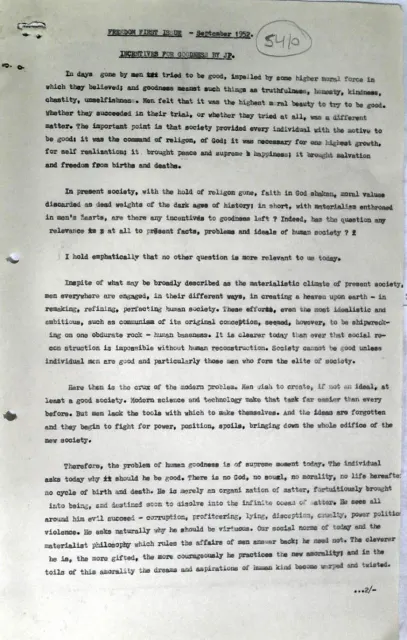
Jayaprakash Narayan’s reprinted “Incentives to Goodness” argues, from the standpoint of a former devotee of dialectical materialism, that social reconstruction is impossible without a corresponding individual moral reconstruction, since materialism cannot supply a rational reason to be good.
Essays
Between Ourselves
In the rendered pages, “Between Ourselves” dedicates the 500th issue to Freedom First’s readers and supporters, using a reader’s letter to present the magazine as a source of balanced, intellectual, and unbiased commentary. In the rendered pages, the editor thanks donors, advertisers, contributors, editors, and contributing editors, and explains that the commemorative issue was difficult to assemble because it had to select fewer than forty articles from fifty-six years of publication.
- Dedicates the 500th issue to readers and supporters of Freedom First.
- Quotes a reader praising the magazine’s balanced coverage of current affairs.
- Names past editors and acknowledges the founder, Minoo Masani.
- Explains that the selection spans fifty-six years and excludes the six-month 1975 Emergency suspension.
The Evolution of Freedom First
In the rendered pages, “The Evolution of Freedom First” locates the magazine’s origins in post-independence India, when nationalist hopes, socialist planning, and admiration for the Soviet Union shaped public debate. In the rendered pages, the piece says Freedom First began in June 1952 to defend cultural freedom, expose Soviet communism and its Indian supporters, and develop a liberal alternative that included free enterprise, secular values, minority rights, and intellectual openness.
- Places Freedom First against the post-1947 rise of planning and socialist thought.
- Argues that many Indian leaders underestimated Soviet totalitarianism.
- Describes the journal’s June 1952 launch as a defence of cultural freedom.
- Presents Freedom First as a liberal alternative to socialism and communist influence.
The Open Society
In the rendered pages, “The Open Society” defines Freedom First’s first purpose as resisting the drift from personal responsibility into authoritarian security. In the rendered pages, it argues that India’s own intellectual inheritance valued open debate and dissent, and that the Movement for Cultural Freedom should preserve the realm of mind against regimentation, mass conformity, and the temptation to suppress doubt.
- Contrasts freedom and responsibility with surrender to a Leviathan-like authority.
- Claims Indian intellectual traditions prized free debate even amid social regimentation.
- Treats dissent and criticism as necessary to truth and social progress.
- Defines the Movement for Cultural Freedom as a defence of open minds and open debate.
Rededication
In the rendered pages, “Rededication” renews Freedom First’s founding commitment to open society and free debate in the face of what it calls a Marxist counter-revolution and direct attacks on fundamental freedoms. In the rendered pages, Minoo Masani cites Jayaprakash Narayan’s criticism of the 25th Amendment, warns that press freedom is in danger, and argues that small independent journals may have to preserve the liberal flame.
- Reaffirms the 1952 aim of keeping the windows of mind and heart open.
- Treats constitutional amendments and state power as threats to democratic foundations.
- Highlights press freedom as especially vulnerable.
- Presents Freedom First as a small journal with a duty to keep dissent alive.
A Tiff with the Establishment
In the rendered pages, “A Tiff with the Establishment” answers Prime Minister Nehru’s parliamentary criticism of the Indian Committee for Cultural Freedom and the Democratic Research Service. In the rendered pages, the article insists that both organisations are independent democratic bodies, defends their anti-communist publications and criticism of government policy on Hungary and Tibet, and argues that they are in respectable international company when they condemn Soviet repression.
- Responds directly to Nehru’s charge that anti-communist cultural organisations were political fronts.
- Lists Indian and international figures associated with the Indian Committee for Cultural Freedom.
- Defends the Democratic Research Service as publicly funded within India and openly critical.
- Uses the Hungarian uprising to justify criticism of Soviet communism and of Indian government softness toward it.
Mill “On Liberty”
In the rendered pages, R. A. Jahagirdar’s “Mill ‘On Liberty’” marks the 150th anniversary of John Stuart Mill’s book and treats it as central to Freedom First’s own concern with liberty. In the rendered pages, the article sketches Mill’s education, his relationship with Harriet Taylor, the book’s harm principle, later criticism by James Fitzjames Stephen and H. L. A. Hart, and the continuing usefulness of Mill’s defence of discussion and individuality.
- Presents On Liberty as an appropriate tribute for Freedom First’s 500th issue.
- Explains Mill’s harm principle and the defence of unpopular opinion.
- Emphasises experiments in living, individuality, and limits on social coercion.
- Notes later criticisms while affirming Mill’s lasting service to liberty.
Incentives to Goodness
By Jayaprakash Narayan
In the rendered pages, Jayaprakash Narayan’s “Incentives for Goodness” argues that modern society cannot achieve social reconstruction unless it restores incentives for individual moral reconstruction. In the rendered pages, Narayan writes from the standpoint of a former devotee of dialectical materialism, contending that materialism cannot provide a rational reason to be good and that the character of social elites shapes the destiny of society.
- Contrasts older religious incentives for goodness with modern materialist assumptions.
- Argues that social reconstruction fails without individual moral reconstruction.
- States that materialism cannot logically require deliberate goodness.
- Warns that ordinary decency can collapse under social passions and elite amorality.
Generated by the v1.5 extraction pipeline. Awaiting editorial review.
Metadata and summary are AI-extracted from the source PDF and reviewed for editorial accuracy. The original work is available via the Read PDF tab above (where present); paragraph-level citation inside the PDF is deferred to a future engagement.