
circular
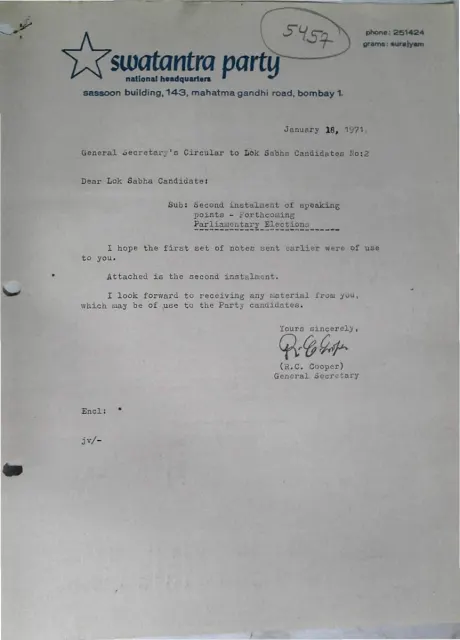
General Secretary's Circular to Lok Sabha Candidates No:2
swatantra party national headquarters · Bombay · 1971
6 pages
Summary
This 18 January 1971 Swatantra Party circular, issued by General Secretary R. C. Cooper to Lok Sabha candidates, supplies a second instalment of speaking points for the forthcoming parliamentary election. Its central attack is on the Congress government, which it portrays as having betrayed public confidence through inflation, unemployment, industrial unrest, nationalisation, excessive taxation, and poorly directed public expenditure. The circular argues that the government invokes socialism while impeding production and investment and prioritising items such as the small car and television over basic necessities.
The speaking points also address regional inequality and labour relations. They call for greater economic attraction to backward regions and for a more responsible industrial-relations framework in which trade-union rights are protected but strikes are a last resort, with wages linked to productivity. Attached extracts from the Indian Express extend the critique by contrasting Indian political rhetoric about socialism with Swiss living standards and wage structures, and by urging Piloo Mody’s production-and-employment alternative. A final extract raises questions about India’s position amid growing Soviet and Anglo-American naval activity in the Indian Ocean, asking the government to clarify its strategic preferences.
Key points
- The circular frames the Congress government as responsible for social disorder, inflation, unemployment, industrial unrest, and declining public confidence.
- It argues that Congress uses socialist slogans while imposing policies that restrict production, discourage investment and savings, and expand unproductive public expenditure.
- The document highlights regional disparities between metropolitan, tribal, and backward areas and proposes increasing their economic attractiveness.
- Its labour-policy proposal combines protected trade-union rights with greater responsibility, conciliation before strikes, and a statutory link between wages and productivity.
- An attached Indian Express extract contrasts Indian claims of socialism with Swiss wages, housing, and worker living standards.
- Piloo Mody is quoted as arguing that increased production is the best route to eliminating poverty and that employment is the best means of distributing wealth.
- The final extract asks Indira Gandhi to clarify India’s position toward Soviet and Anglo-American naval power in the Indian Ocean.
Metadata and summary are AI-extracted from the source PDF and reviewed for editorial accuracy. The original work is available via the Read PDF tab above (where present); paragraph-level citation inside the PDF is deferred to a future engagement.
Related across the archive
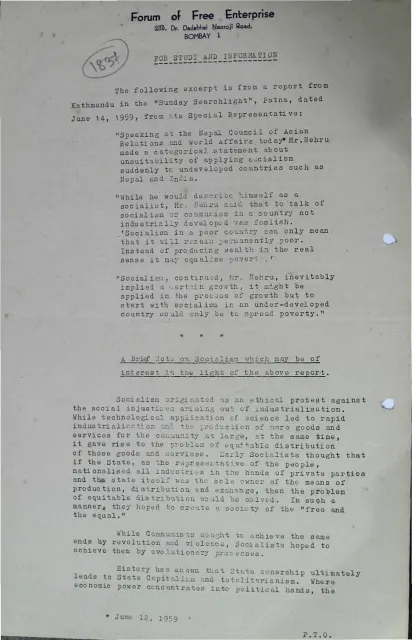 Primary workFor Study and Information
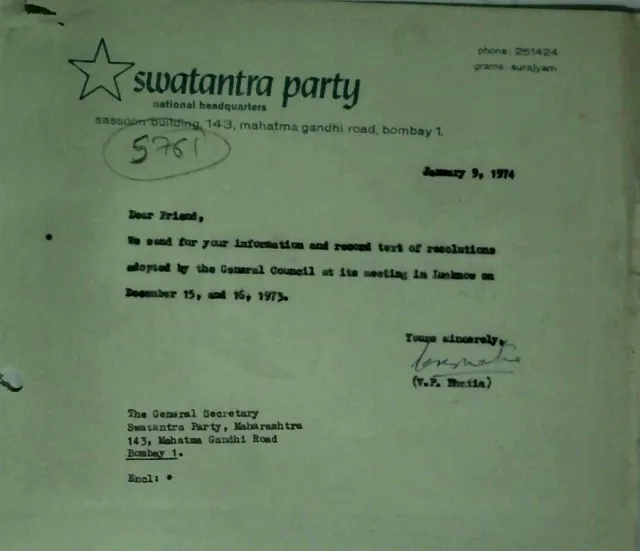 Primary workRESOLUTIONS
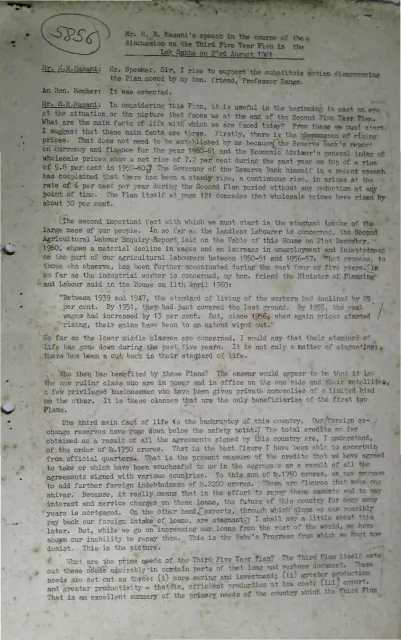 Primary workMr. M. R. Masani's speech in the course of the discussion on the Third Five Year Plan in the Lok Sabha on 2nd August 1961
 ThePrintCapitalism isn’t responsible for mass unemployment. Look at Japan, Singapore: BS Iyer
 ExcerptSocialism or State Capitalism