Summary
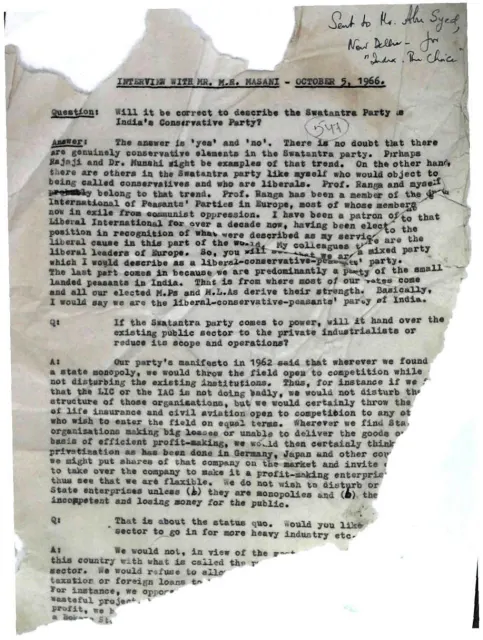
This interview with Minoo Masani, conducted on October 5, 1966, presents the Swatantra Party as a hybrid formation: liberal in its economic and constitutional commitments, conservative in some of its membership, and primarily rooted in India’s small landed peasantry. Masani argues for competition, private initiative, and sharply limited state enterprise. He would preserve public enterprises that function efficiently, but open monopolies to competition and consider privatization when state organizations are incompetent, loss-making, or obstructive. The state’s essential responsibilities, in his account, are infrastructure, water, irrigation, electricity, transport, communications, technical training, and regulation against exploitation—not the production of every commodity or service.
The interview also develops Masani’s critique of socialism and Marxism, his defence of decentralized peasant proprietorship, and his argument that India’s electoral system misrepresents popular preferences. He advocates proportional representation, rejects an alliance with the Jana Sangh while supporting electoral understandings among democratic opposition parties, and describes the Swatantra Party’s base as predominantly rural. In foreign-policy discussion, he takes a strongly anti-communist position on Vietnam, Kashmir, China, and the Soviet Union. He presents the party’s philosophy as a fusion of Gandhi’s influence with modern liberal principles, while rejecting absolute pacifism and austerity. The visible pages end in the middle of the interview’s discussion of communism, civil liberties, and the political Left.
Transcript
Summary
This interview with Minoo Masani, conducted on October 5, 1966, presents the Swatantra Party as a hybrid formation: liberal in its economic and constitutional commitments, conservative in some of its membership, and primarily rooted in India’s small landed peasantry. Masani argues for competition, private initiative, and sharply limited state enterprise. He would preserve public enterprises that function efficiently, but open monopolies to competition and consider privatization when state organizations are incompetent, loss-making, or obstructive. The state’s essential responsibilities, in his account, are infrastructure, water, irrigation, electricity, transport, communications, technical training, and regulation against exploitation—not the production of every commodity or service.
The interview also develops Masani’s critique of socialism and Marxism, his defence of decentralized peasant proprietorship, and his argument that India’s electoral system misrepresents popular preferences. He advocates proportional representation, rejects an alliance with the Jana Sangh while supporting electoral understandings among democratic opposition parties, and describes the Swatantra Party’s base as predominantly rural. In foreign-policy discussion, he takes a strongly anti-communist position on Vietnam, Kashmir, China, and the Soviet Union. He presents the party’s philosophy as a fusion of Gandhi’s influence with modern liberal principles, while rejecting absolute pacifism and austerity. The visible pages end in the middle of the interview’s discussion of communism, civil liberties, and the political Left.
Key points
- Masani describes Swatantra as a “liberal-conservative-peasants’ party” rather than simply India’s Conservative Party.
- He supports competition in state-monopoly sectors and selective privatization of inefficient or loss-making enterprises.
- He assigns the state responsibility for infrastructure and minimum regulation, while leaving production to private enterprise.
- He defends family-based peasant proprietorship and opposes aggregating economic power through large-scale farming.
- He attacks the Soviet model as economically and politically unsuccessful and favours decentralized competitive enterprise.
- He advocates proportional representation to correct distortions produced by India’s electoral system.
- He connects Swatantra’s political outlook to Gandhi, trusteeship, non-violence in domestic politics, and liberal constitutionalism.
- He supports tolerance of communist parties except where there is a clear and present danger to democracy or national security.
Metadata and summary are AI-extracted from the source PDF and reviewed for editorial accuracy. The original work is available via the Read PDF tab above (where present); paragraph-level citation inside the PDF is deferred to a future engagement.