letter
General Secretarys letter no-229
Swatantra Party · Bombay 1 · 1970
5 pages
Summary
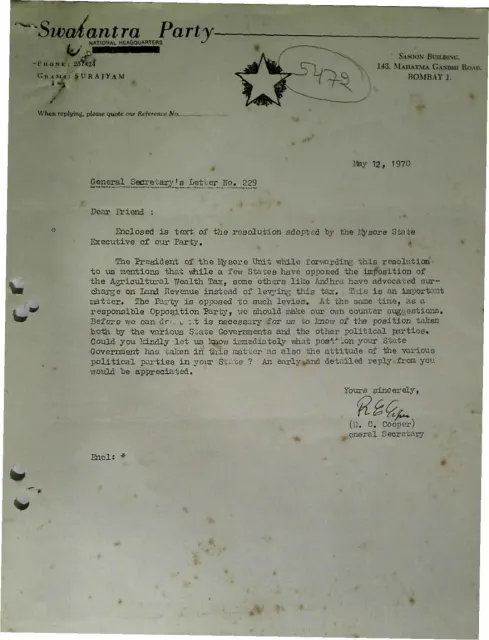
This Swatantra Party General Secretary’s Letter No. 229, dated May 12, 1970, forwards a resolution adopted by the Mysore State Executive opposing the implementation of the Agricultural Wealth Tax Act. The covering letter asks party contacts to report the positions taken by their state governments and political parties, emphasizing that the party should formulate its opposition only after gathering information from across the country.
The enclosed resolution argues that agricultural land valuation would be impracticable because soil, size, weather, and improvements vary substantially; that more than half of the revenue might be absorbed by administrative costs; and that collection would encourage corruption and litigation. It further contends that the tax would reduce farmers’ incentives to improve land and crops and eventually diminish food-grain supplies. The attached June 20 circular and handwritten Maharashtra memorandum broaden the documentation request to tenancy, land ceilings, agricultural wages, landholding patterns, and the state’s position on agricultural wealth taxation. The Maharashtra notes list existing tenancy and land-ceiling legislation, provide approximate holding sizes and labour remuneration, and claim that large landowners support the Congress and have divided holdings among relatives to evade ceiling laws.
Key points
- The May 12, 1970 letter transmits a Mysore State Executive resolution opposing the Agricultural Wealth Tax Act.
- The Swatantra Party seeks state-level information before finalizing its opposition as a responsible opposition party.
- The resolution criticizes agricultural land valuation as administratively impracticable and likely to generate complaints.
- It predicts that collection costs, corruption, and litigation could consume much of the tax revenue.
- It argues that agricultural taxation would weaken incentives to improve land and increase production, while reducing food-grain supplies.
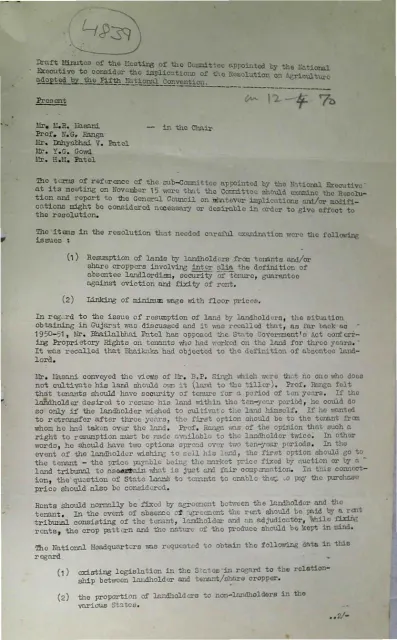
- The June 20 circular requests state legislation and data on tenancy, land ceilings, agricultural minimum wages, landholding proportions, holding sizes, and actual labour remuneration.
- The handwritten Maharashtra memorandum describes tenancy, land-ceiling, wage, and landholding conditions and alleges evasion of land-ceiling legislation by large landowners.
Metadata and summary are AI-extracted from the source PDF and reviewed for editorial accuracy. The original work is available via the Read PDF tab above (where present); paragraph-level citation inside the PDF is deferred to a future engagement.