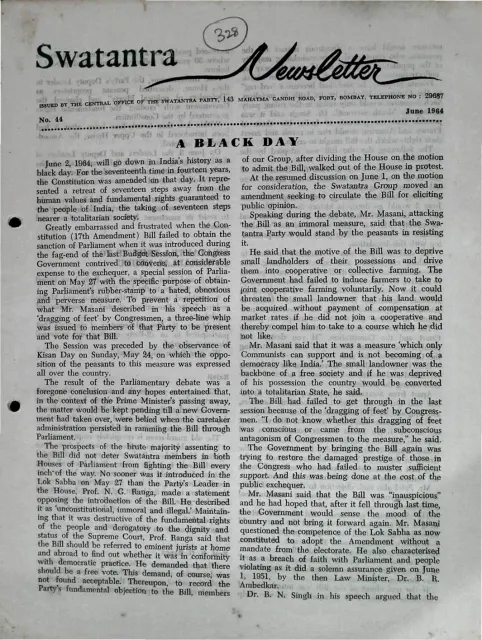
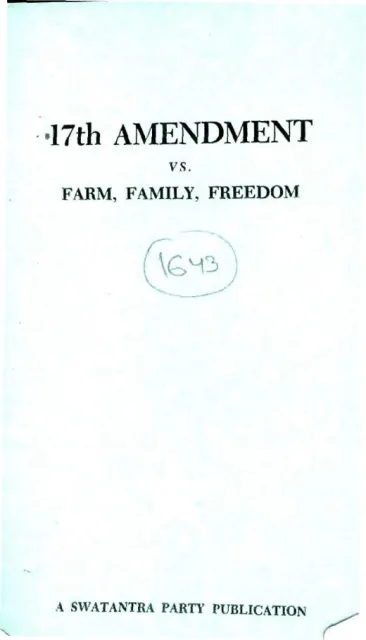
letter
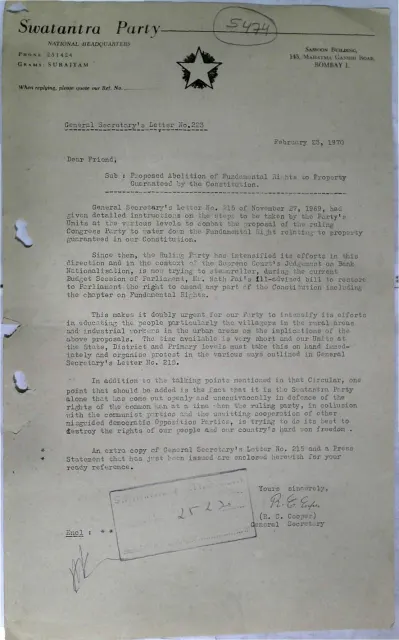
General Secretarys letter no-223
Swatantra Party · Bombay · 1970
5 pages
Summary
This five-page Swatantra Party communication, issued from Bombay on February 23, 1970 as General Secretary’s Letter No. 223, urges party units to oppose the proposed abolition of the constitutional fundamental right to property. It argues that removing the right would threaten small farmers and village shopkeepers by exposing their land and businesses to government acquisition without adequate compensation. The letter frames the proposal as part of a broader effort by Indira Gandhi’s Congress (Marxist) party and allied Communist forces to undermine Indian democracy.
The accompanying November 27, 1969 circular turns this opposition into an organising programme. It instructs state, district, and primary units to translate and distribute the circular in regional languages, educate rural communities, hold meetings and discussions, organise Kisan Marches, and coordinate petitions and signature campaigns. It also proposes locally financed party work and a “Protect the Small Farmer & Small Shopkeeper Day.”
The enclosed press statement, “TWIN BODIES REVIVED,” reiterates that property includes the modest assets of poor cultivators, village shops, workers, and ordinary families, not merely the wealth of large industrialists or princes. Across the rendered pages, the party presents property rights as an individual safeguard, a protection for rural livelihoods, and a condition of democratic government.
Key points
- The letter calls for intensified opposition to the proposed constitutional abolition of the fundamental right to property.
- It argues that small farmers could lose their land and become landless labourers, while village shopkeepers could lose their businesses and become government employees.
- The document portrays Indira Gandhi’s Congress (Marxist) party as Communist-controlled and as a threat to Indian democracy.
- Party units are instructed to educate rural voters through translated circulars, meetings, discussions, marches, petitions, and signature campaigns.
- The proposed campaign is to be locally financed through small contributions from farmers, shopkeepers, and larger donations from wealthier villagers.
- The Swatantra Party distinguishes its defence of small property holders from support for big business and links its position to “Social Justice.”
- The enclosed press statement broadens the meaning of property to include tools, vehicles, personal belongings, and the modest assets of poor families.
Metadata and summary are AI-extracted from the source PDF and reviewed for editorial accuracy. The original work is available via the Read PDF tab above (where present); paragraph-level citation inside the PDF is deferred to a future engagement.