Summary
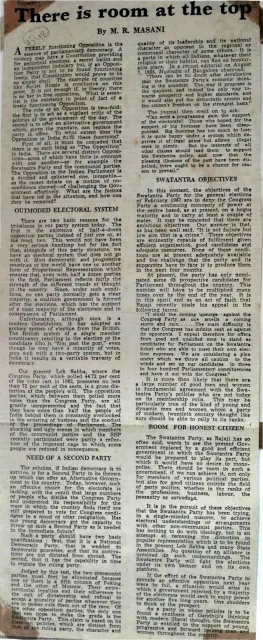
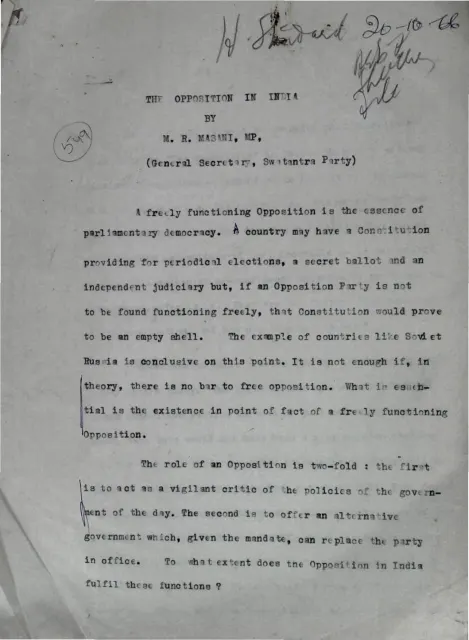
In this essay, M. R. Masani argues that a freely functioning opposition is essential to parliamentary democracy: elections, a constitution, and an independent judiciary are insufficient if opposition parties cannot operate effectively. He defines the opposition’s two duties as criticizing the government and presenting an alternative government capable of replacing it. The essay rejects the idea of a single, unified opposition in India, describing instead a fragmented field that includes the Swatantra Party and Communist parties.
Masani attributes the weakness of India’s opposition to the proliferation of parties and to the first-past-the-post electoral system, which he argues produces severe distortions in representation. He cites the 1962 Lok Sabha results, in which Congress received 44.72 percent of the votes but won 72 percent of the seats, as evidence that opposition voters were underrepresented. The proposed remedy is a democratic, national, non-Communist second party with clear policies and the capacity to replace Congress. The essay presents the Swatantra Party as the only existing opposition party that meets these conditions, and discusses its preparations for the February 1967 elections, including candidate recruitment, electoral understandings with other non-Communist parties, and a commitment not to monopolize government.
Key points
- A functioning opposition is presented as indispensable to parliamentary democracy, beyond formal constitutional guarantees.
- The opposition has two roles: vigilant criticism of government policy and preparation of an alternative government.
- India’s opposition is fragmented among several parties, weakening its ability to challenge Congress effectively.
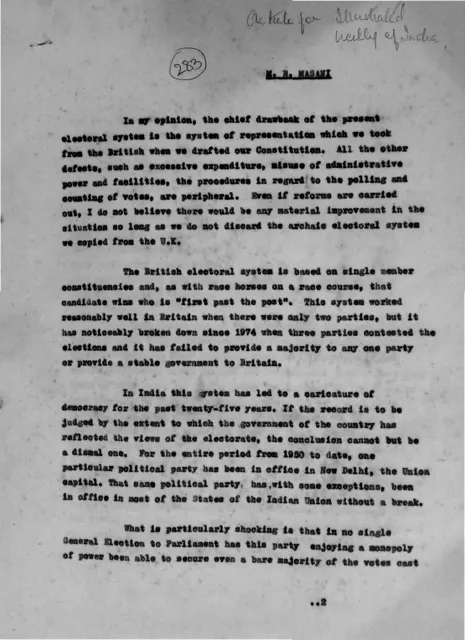
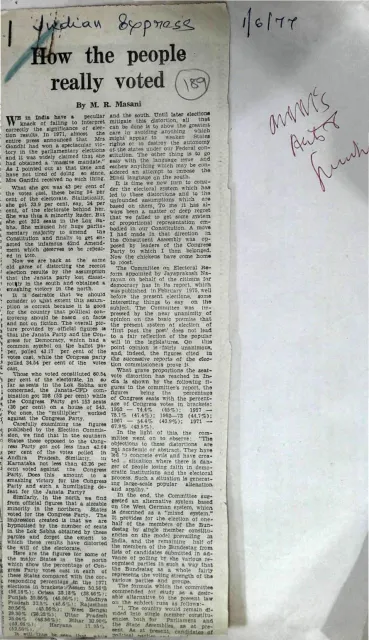
- The first-past-the-post electoral system is criticized for distorting the relationship between votes and parliamentary seats.
- Masani cites the 1962 result—44.72 percent of votes and 72 percent of seats for Congress—as evidence of that distortion.
- The essay argues for a national, democratic, non-Communist second party capable of replacing the ruling party.
- The Swatantra Party is presented as the strongest candidate for that role, with a platform combining Gandhi’s thinking and modern liberal thought.
Metadata and summary are AI-extracted from the source PDF and reviewed for editorial accuracy. The original work is available via the Read PDF tab above (where present); paragraph-level citation inside the PDF is deferred to a future engagement.