financial record
For Favour of Publication
Swatantra Party CENTRAL OFFICE · Bombay · 1966
12 pages
Summary
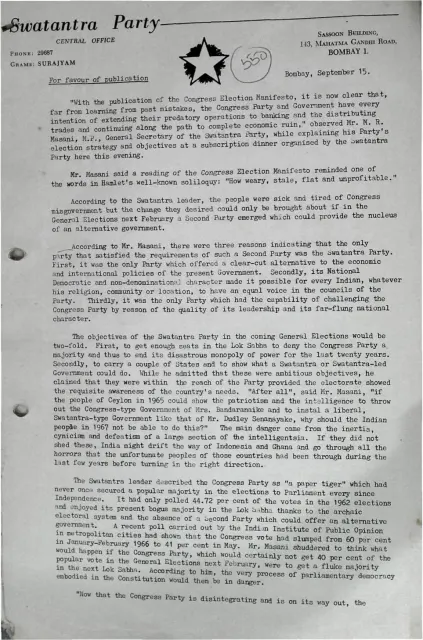
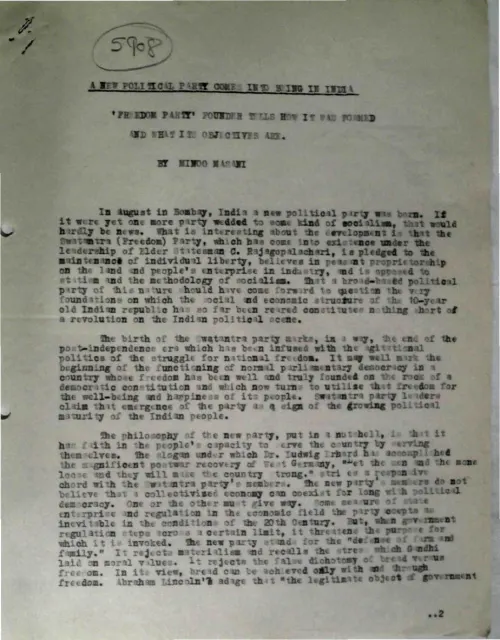
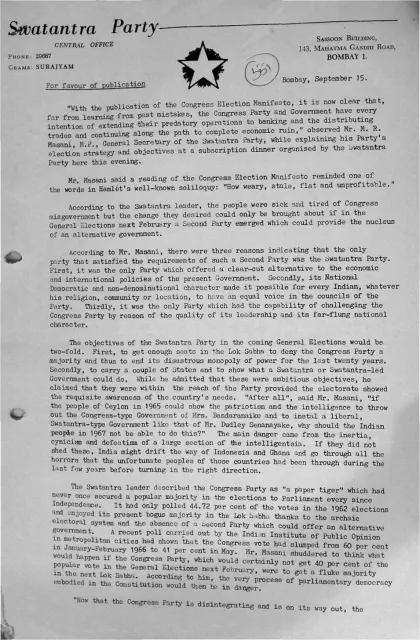
This Swatantra Party publication note reports M. R. Masani’s remarks at a subscription dinner in Bombay on the party’s strategy for the forthcoming General Elections. Masani presents the Swatantra Party as the necessary “Second Party” capable of ending Congress’s long monopoly of power while rejecting both Congress statism and Communist authoritarianism. He identifies the party’s appeal as democratic, non-denominational, rural, and committed to free enterprise, peasant proprietorship, and free trade unions. Its immediate objectives are to deny Congress a Lok Sabha majority and to win control of a small number of states in order to demonstrate what Swatantra-led governments could achieve.
The note combines electoral argument with a defence of economic liberty. Masani attacks the Congress manifesto’s proposals for banking and trade nationalisation and urban-income ceilings, warns that an electoral system can convert a minority vote into a parliamentary majority, and argues that the party’s main challenge is not peasant support but the failure of business and the intelligentsia to organise behind liberal alternatives. He urges supporters to overcome cynicism, provide candidates and funds, and join the party’s “Open Conspiracy” to replace Congress with a “new, clean and efficient government.”
Key points
- M. R. Masani frames the Swatantra Party as the democratic alternative to Congress and Communism.
- The party seeks to end Congress’s two-decade monopoly in Delhi and win enough states to demonstrate its governing capacity.
- Its stated social base is rural India, especially peasants, rather than urban business interests.
- The publication defends free enterprise, peasant proprietorship, and free trade unions as foundations of a free society.
- Masani criticises Congress proposals for nationalising banking and trading activities and imposing ceilings on urban incomes.
- The note argues that India’s electoral system can turn a minority vote into a parliamentary majority, making opposition coordination essential.
- Masani calls on businesspeople and intellectuals to provide money, candidates, printed literature, transport, and political organisation.
Metadata and summary are AI-extracted from the source PDF and reviewed for editorial accuracy. The original work is available via the Read PDF tab above (where present); paragraph-level citation inside the PDF is deferred to a future engagement.