essay
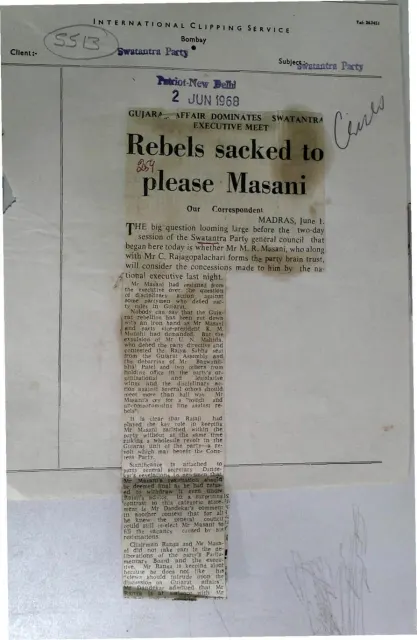
Rebels sacked to please Masani
Patriot-New Delhi · New Delhi · 1968
2 pages
Summary
This 2 June 1968 Patriot-New Delhi report describes a crisis inside the Swatantra Party executive, where disciplinary action against Gujarat leaders had become entangled with M. R. Masani’s resignation. The article says the party’s general council was considering concessions intended to persuade Masani—identified alongside C. Rajagopalachari as part of the party’s “brain trust”—to withdraw his resignation.
The report presents the Gujarat dispute as a test of party discipline and leadership. It recounts objections to the expulsion of U. N. Mahida, the removal of Raijsa Sabha member Gujarati Patel, and the debarring of other office-holders, while suggesting that Masani wanted a firm response to the rebels. It also reports disagreement over whether senior leaders, including Rajaji, had encouraged revolt, and notes procedural tensions involving the party’s Parliamentary Board and executive. The visible article ends mid-sentence, so the clipping does not provide the complete report.
Key points
- The Swatantra Party general council met amid a dispute over disciplinary action in Gujarat.
- M. R. Masani’s resignation and the possibility of concessions to him were presented as the meeting’s central question.
- The report links the crisis to the expulsion or removal of several Gujarat party figures.
- Masani was described as seeking a firm and uncompromising response to party rebels.
- The article says Rajaji’s role in keeping Masani satisfied was politically significant.
- Questions were raised about whether Rajaji had encouraged a revolt in the Gujarat unit.
- The report records disagreement over the participation of party leaders in the Parliamentary Board and executive.
Metadata and summary are AI-extracted from the source PDF and reviewed for editorial accuracy. The original work is available via the Read PDF tab above (where present); paragraph-level citation inside the PDF is deferred to a future engagement.