Summary
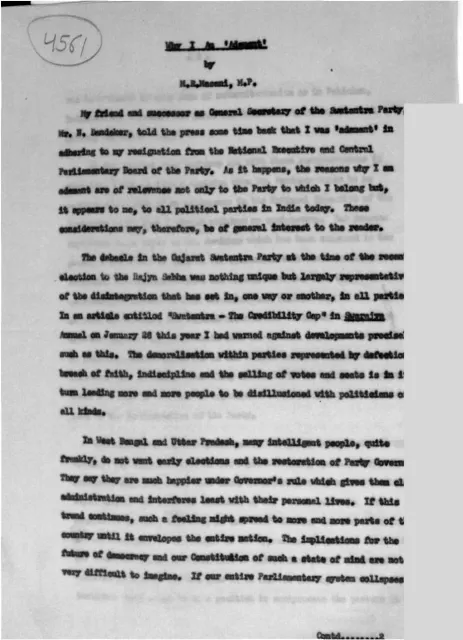
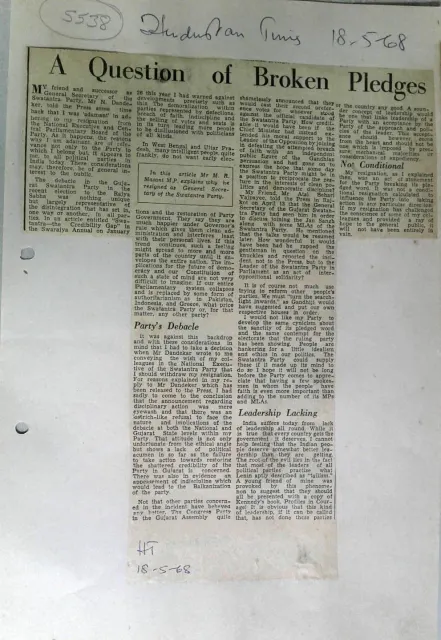
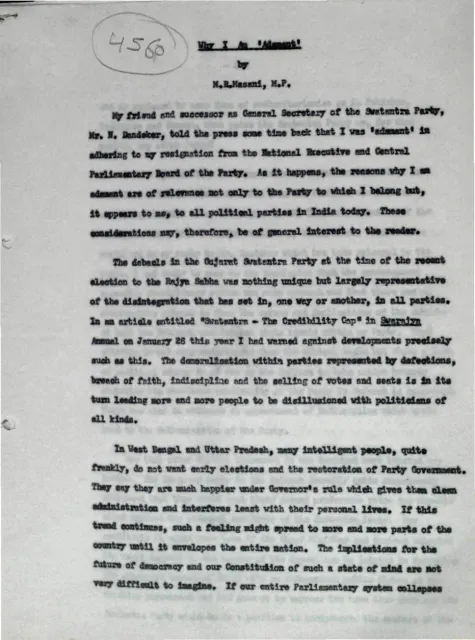
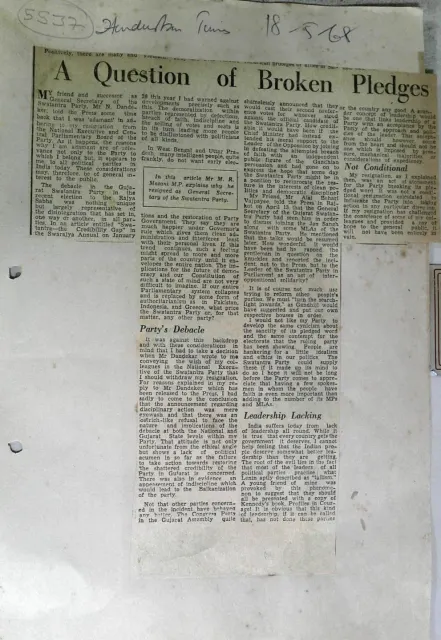
In this Hindustan Times article, Minoo Masani explains his resignation as General Secretary of the Swatantra Party after what he describes as a breakdown of party discipline and a failure to uphold public commitments. He presents the Gujarat election and the party’s response to defections as evidence of a wider credibility gap, arguing that indiscipline and evasive leadership could damage both the party and parliamentary democracy.
Masani rejects the idea that the Swatantra Party should imitate other parties or dilute its principles. He calls instead for fidelity to its pledged commitments, clearer leadership, and a politics grounded in ideals and ethics. The article also criticises the broader failure of leadership in India, while warning that democratic institutions become vulnerable when parties tolerate opportunism and refuse to confront misconduct.
Key points
- Masani says he resigned as General Secretary because of the Swatantra Party’s handling of defections and disciplinary failures.
- The Gujarat election is presented as a test of the party’s credibility and representative character.
- The article warns that party indiscipline and opportunism can contribute to the collapse of parliamentary government.
- Masani argues that the Swatantra Party should not reform itself by copying other parties.
- The party’s pledged word and commitment to democratic politics are treated as central to its identity.
- The article broadens its criticism from party conduct to the lack of leadership in India generally.
- Masani stresses that political ideals and ethics matter more than merely increasing the number of legislators.
Metadata and summary are AI-extracted from the source PDF and reviewed for editorial accuracy. The original work is available via the Read PDF tab above (where present); paragraph-level citation inside the PDF is deferred to a future engagement.