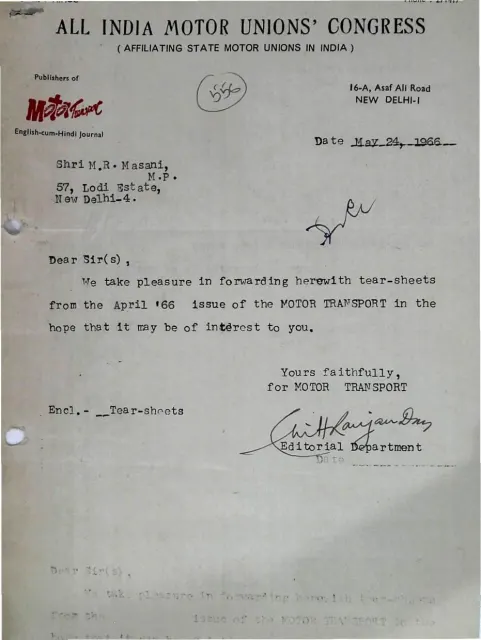
letter
Letter to Mr Minoo Masani
Publishers of Motor Transport · NEW DELHI-1 · 1966
9 pages
Summary
This 24 May 1966 letter from the All India Motor Unions’ Congress, signed on behalf of the Editorial Department of Motor Transport, forwards tear-sheets from the journal’s April 1966 issue to M. R. Masani. The principal enclosed item is a report of Masani’s Lok Sabha intervention on road transport, tourism, aviation, and industrial relations. Because the document combines a brief forwarding letter with reproduced journal pages, the authorship of the enclosed speeches should not be attributed to the letter’s unidentified signatory.
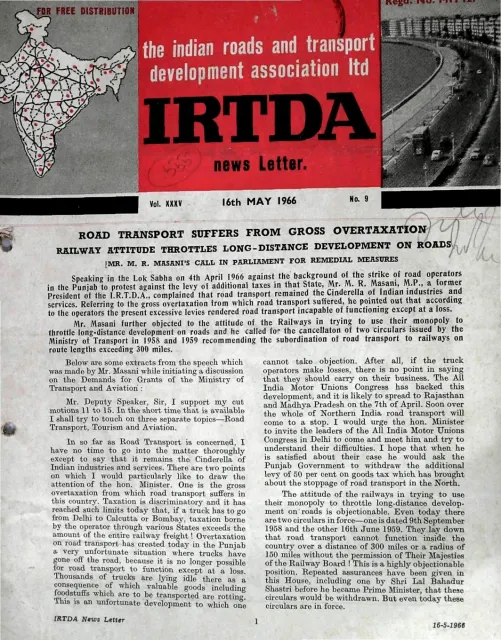
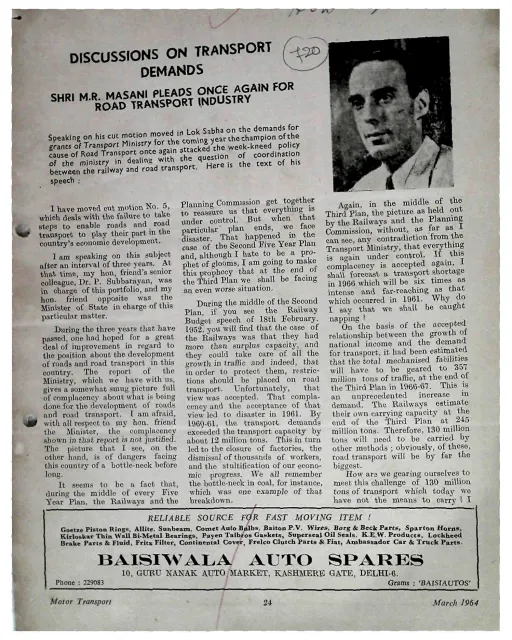
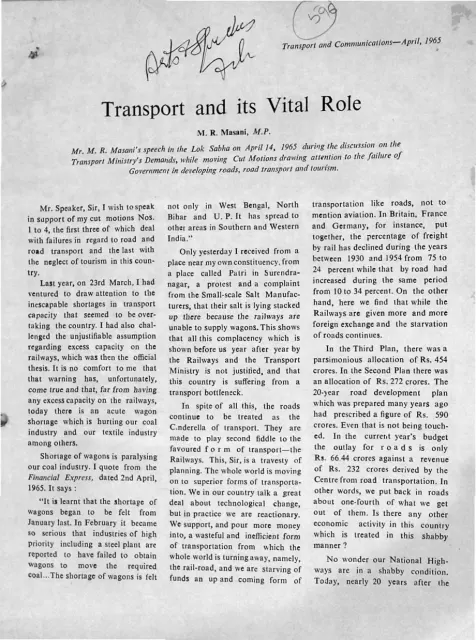
In the rendered pages, Masani argues that road transport is being hindered by discriminatory taxation, restrictive railway regulations, inadequate coordination, and the failure to develop a coherent tourism policy. He presents road transport as faster, cheaper, more flexible, and more employment-intensive than railways, while calling for improved highways, border roads, inter-State permits, and an autonomous authority to promote tourism. The later pages also address the rule of law in industrial disputes: Masani supports collective bargaining and the right to strike, but condemns illegal or wildcat strikes and urges the government to enforce settled awards and statutory notice requirements. A separate speech by P. C. Barooah similarly emphasizes road transport’s role in economic development and its advantages in speed, cost, and reach.
Key points
- The document is a forwarding letter dated 24 May 1966, enclosing tear-sheets from the April 1966 issue of Motor Transport.
- The enclosed material reproduces M. R. Masani’s Lok Sabha arguments on road transport, tourism, aviation, and industrial relations.
- Masani criticizes discriminatory road-transport taxation, railway restrictions, and inadequate inter-State transport coordination.
- The speech presents road transport as faster, less expensive to build, more geographically flexible, and more employment-intensive than rail transport.
- Masani proposes a coherent tourism policy, recognition of tourism as an export industry, incentives for hotels and transport firms, and an autonomous tourism authority.
- The industrial-relations discussion distinguishes lawful strikes and collective bargaining from illegal or wildcat strikes, stressing the rule of law.
- P. C. Barooah’s enclosed speech similarly frames transport infrastructure as a prerequisite for economic development, with particular attention to Assam.
Metadata and summary are AI-extracted from the source PDF and reviewed for editorial accuracy. The original work is available via the Read PDF tab above (where present); paragraph-level citation inside the PDF is deferred to a future engagement.