essay
India’s Foreign Policy
By Minoo Masani
Reprinted from united ASIA International Magazine of Afro-Asian Affairs JAN.-FEB. 1966, VOL. XVIII No. 1 12, Rampart Row, Bombay 1. · Bombay · 1966
19 pages
Summary
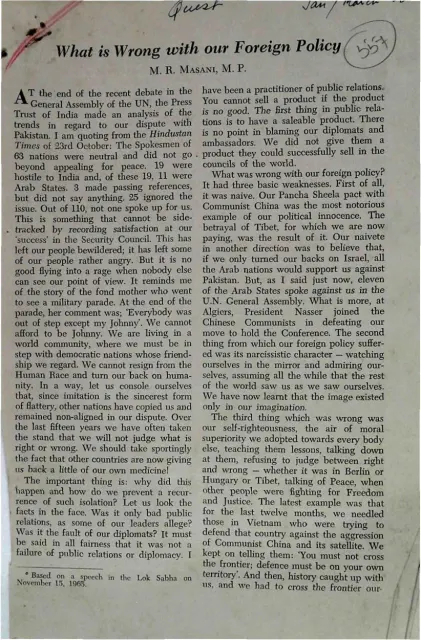
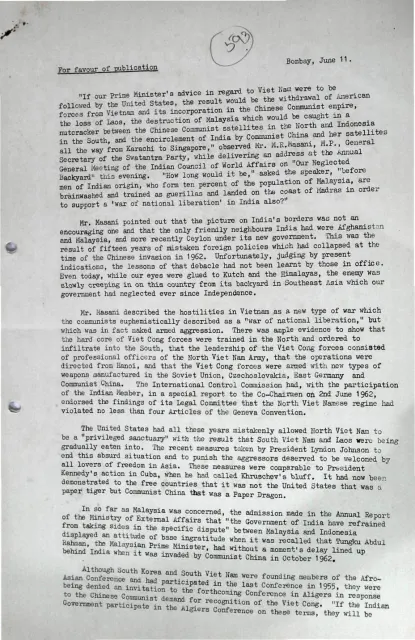
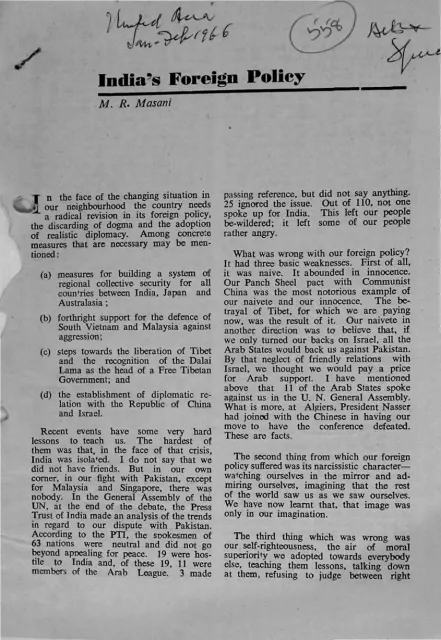
In this essay, M. R. Masani argues that India must radically revise its foreign policy by abandoning ideological dogma in favour of realistic diplomacy. He attributes India’s recent isolation to three weaknesses: naivety, a narcissistic belief that other countries viewed India as Indians viewed themselves, and an attitude of moral self-righteousness. He points to the Panch Sheel agreement with Communist China, India’s treatment of Israel, and its failure to support South Vietnam and Malaysia as examples of this mistaken approach.
Masani identifies Communist China as the principal threat to India’s independence, democratic way of life, and survival. He calls for India to lead a regional security arrangement with Japan and Australia, support the defence of South and Southeast Asian countries, recognise the Tibetan government-in-exile associated with the Dalai Lama, and establish diplomatic relations with both the Republic of China and Israel. He advocates a firm short-term posture toward Pakistan while keeping open the possibility of normal long-term relations, and urges cooperation with both the United States and the Soviet Union rather than an absolutist form of non-alignment. The essay also makes a practical case for American assistance in defence, food, and economic aid, while warning India not to replace one diplomatic illusion with another.
Key points
- Masani calls for a shift from dogmatic non-alignment toward realistic diplomacy.
- He identifies naivety, narcissism, and self-righteousness as the basic defects of India’s foreign policy.
- He presents Communist China as the major threat to India’s independence, democracy, and survival.
- He proposes regional collective security linking India, Japan, Australia, and the countries of South and Southeast Asia.
- He advocates support for South Vietnam and Malaysia, a more active policy on Tibet, and diplomatic relations with the Republic of China and Israel.
- He distinguishes between a firm short-term policy of resisting Pakistan and a long-term policy of restoring necessary friendly relations.
- He argues that India needs cooperation from both superpowers, while especially requiring United States support for defence, food, and economic assistance.
- He rejects the assumption that countries are permanent friends and urges foreign policy based on changing national interests.
Metadata and summary are AI-extracted from the source PDF and reviewed for editorial accuracy. The original work is available via the Read PDF tab above (where present); paragraph-level citation inside the PDF is deferred to a future engagement.