letter
Swatantra Party Letter
Bombay · 1976
2 pages
Summary
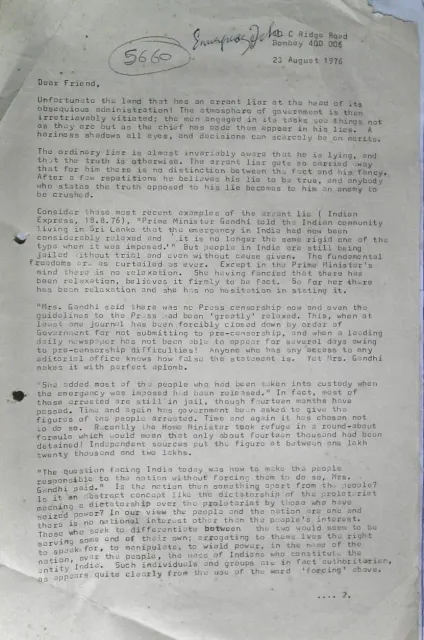
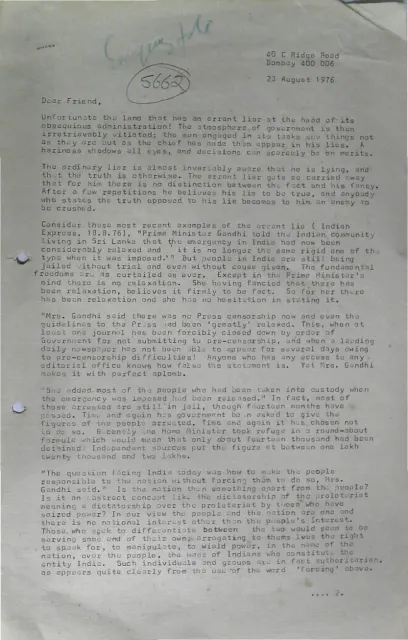
This letter dated 23 August 1976 argues that India’s Emergency has produced an atmosphere in which the government’s claims cannot be trusted and dissent is treated as hostility. It criticizes Prime Minister Indira Gandhi’s statements that the Emergency has been relaxed, that press censorship has ended, and that most detainees have been released, contrasting those claims with continued imprisonment without trial, pre-censorship, and the absence of meaningful civil freedoms.
The letter’s central political argument is that the real issue is not whether the Indian people must be compelled to obey, but how government can be made responsible to them. It rejects the idea that Indians are incapable of democratic self-government because they are poor or illiterate, warning instead that paternalistic arguments for “guidance” and stronger executive power are themselves authoritarian. The letter closes by invoking John Barbour’s praise of freedom as a noble and deeply human value.
Key points
- The letter condemns the Emergency government’s alleged habit of confusing fact with official assertion.
- It challenges Indira Gandhi’s claims that the Emergency and press censorship had been substantially relaxed.
- It reports continued detention without trial and disputes the government’s figures on released prisoners.
- It treats press pre-censorship and restrictions on news publication as evidence that civil freedoms remain curtailed.
- It argues that democratic government must be responsible to the people rather than rule through coercion.
- It rejects elitist claims that poverty or illiteracy make Indians unfit for democracy.
- It warns that paternalistic protection of the people can become authoritarian rule.
- It concludes with a literary affirmation of freedom attributed to John Barbour.
Metadata and summary are AI-extracted from the source PDF and reviewed for editorial accuracy. The original work is available via the Read PDF tab above (where present); paragraph-level citation inside the PDF is deferred to a future engagement.