essay
INDIA'S PROBLEM IS ECONOMIC: SOLUTION IS POLITICAL
Amrit Bazar Patrika, Calcutta · Calcutta · 1966
7 pages
Summary
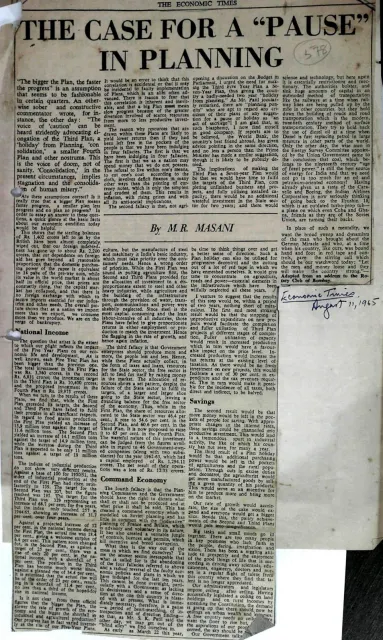
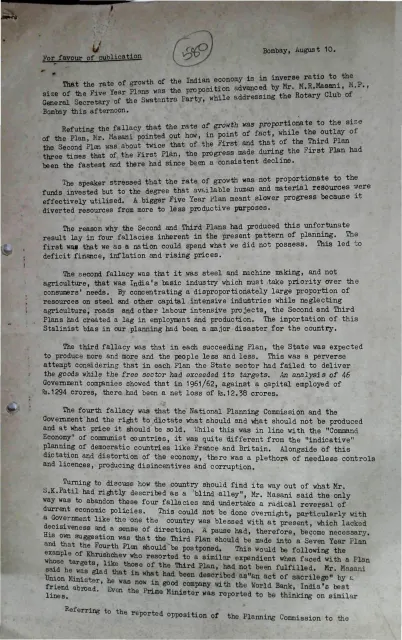
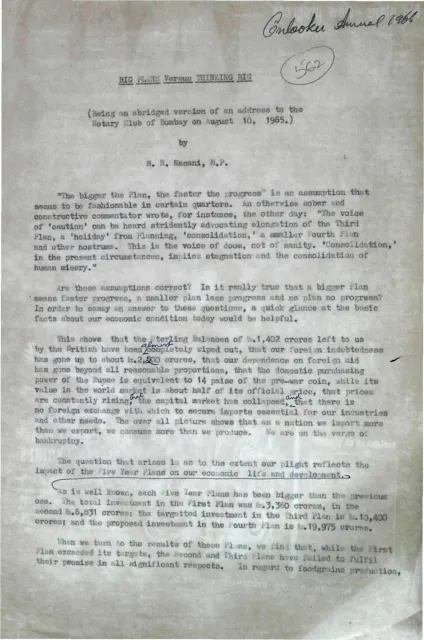
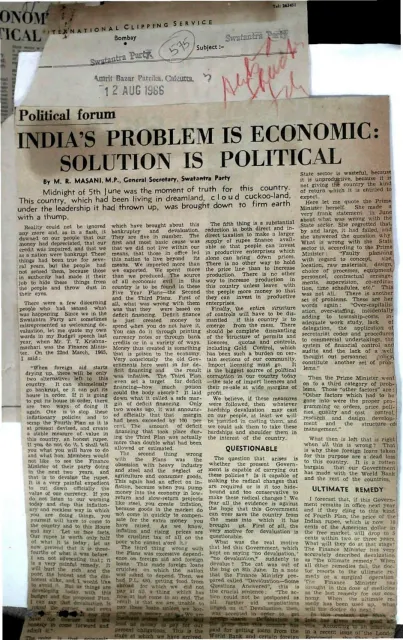
In the rendered pages, M. R. Masani argues that India’s economic crisis is the consequence of political choices: excessive state planning, expanding public-sector commitments, monetary mismanagement, taxation, and controls over production and trade. He identifies several “fallacies” behind the planning regime, including the belief that government should produce ever more, that heavy industry automatically constitutes industrialisation, and that the Planning Commission should dictate what is produced and at what price. The article links these policies to inflation, devaluation, wasteful investment, diminished private-sector resources, and corruption.
In the rendered pages, Masani proposes a two-year “Plan holiday” rather than a further extension of the Five Year Plan. He presents this pause as an opportunity to complete unfinished projects, use existing capacity, reduce red tape, reconsider economic priorities, and redirect resources toward agriculture, roads, and power. He argues that such a change would increase production, savings, investment, rural purchasing power, and tax revenues. The article closes by invoking Ceylon’s shift toward liberal economic policies as evidence that economic problems can have political solutions, while attributing India’s difficulties partly to a lack of decisive leadership and confidence in enterprise.
Key points
- Masani attributes India’s economic difficulties to political decisions rather than unavoidable economic conditions.
- He criticises Five Year Plan priorities, especially heavy-industry investment and the expansion of the state sector.
- The article reports that the state sector’s share of plan resources rose from 46.4 per cent in the First Plan to a proposed 65.05 per cent in the Fourth Plan.
- Masani argues that government is structurally ill-suited to producing manufactured goods and growing food efficiently.
- He condemns the command economy of controls, licences, and permits as a source of reduced incentives and corruption.
- He proposes converting the Third Five Year Plan into a seven-year plan and taking a two-year pause from planning.
- The proposed pause is presented as a way to increase production, savings, investment, rural purchasing power, and tax revenue.
- Ceylon’s liberal economic measures are offered as a contemporary example of political action addressing economic problems.
Metadata and summary are AI-extracted from the source PDF and reviewed for editorial accuracy. The original work is available via the Read PDF tab above (where present); paragraph-level citation inside the PDF is deferred to a future engagement.