
speech · parliamentary
Mr. M. R. Masani's speech in the course of the discussion on the Companies (Amendment) Bill, 1959, in the Lok Sabha on 16.11.1960
By Minoo Masani
1960
10 pages
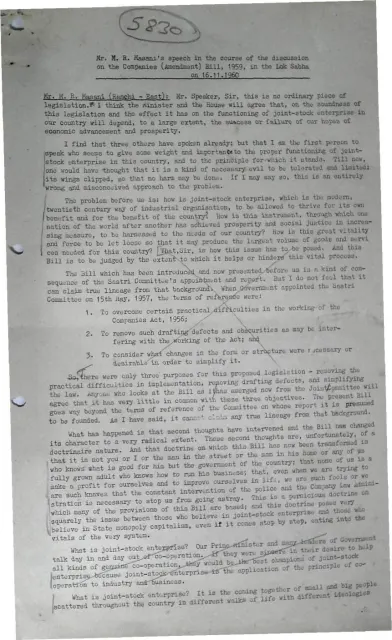
Summary
In this speech, delivered in the Lok Sabha on 16 November 1960 during discussion of the Companies (Amendment) Bill, 1959, M. R. Masani argues that joint-stock enterprise is essential to India’s industrial development and prosperity, but that the Bill departs radically from the Sastri Committee’s limited mandate. He contends that its provisions would impose unnecessary bureaucratic control over private companies, weaken property rights, and replace the judgment of shareholders and managers with that of government officials. Masani presents shareholders as “full-grown citizens” capable of managing their own property and insists that Company Law should provide only the minimum necessary supervision, while protecting minority shareholders against genuine abuse.
The speech examines statutory audits, government intervention in business decisions, restrictions on selling agents, government vetoes over share transfers, and the proposed regulation of corporate contributions to political parties. Masani maintains that competition, rather than administrative discretion, should discipline inefficient or harmful enterprises; he warns that state-directed interference could produce a class of bureaucratic or state capitalists. On political contributions, he argues that companies should not be compelled or permitted to divert money entrusted for production into party financing, and calls for transparency and safeguards. The transcript ends on printed page 10 while Masani is still discussing amendments intended to prevent corporate funds from being used for political purposes.
Key points
- Masani says the Bill exceeds the Sastri Committee’s purposes of resolving practical difficulties, correcting drafting defects, and simplifying the Companies Act.
- He defends joint-stock enterprise as an application of cooperation to industry and business, rather than a necessary evil.
- He argues that shareholders and company owners should retain maximum freedom, subject to safeguards against oppression and fraud.
- He attacks subjective government tests such as whether a company is being run according to “sound business principles or prudent commercial practices.”
- He proposes judicial and procedural safeguards before statutory audits or other intrusive government interventions.
- He opposes government control over selling agents and share transfers, arguing that competition should determine which businesses survive.
- He criticizes corporate political contributions as a diversion of funds from productive purposes and a potential source of coercion and vested interests.
Metadata and summary are AI-extracted from the source PDF and reviewed for editorial accuracy. The original work is available via the Read PDF tab above (where present); paragraph-level citation inside the PDF is deferred to a future engagement.
People in this work
Related across the archive
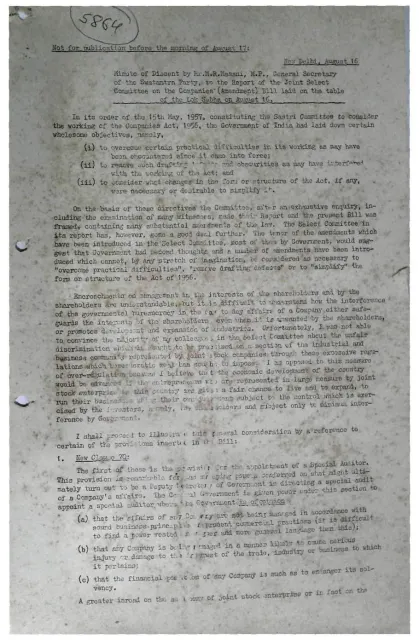 Primary workMinute of Dissent
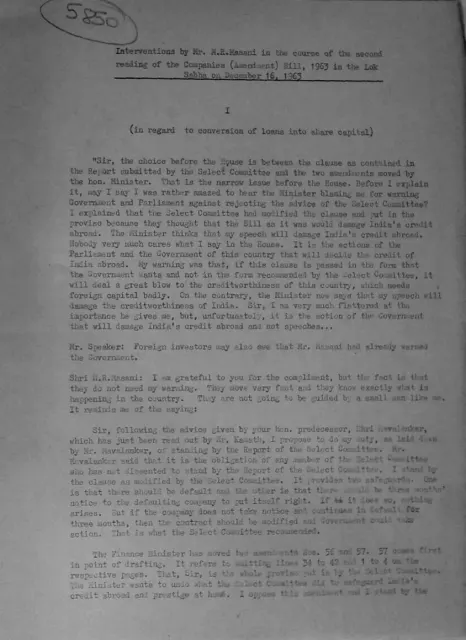 Primary workInterventions by Mr. K.R.Masani in the course of the second reading of the Companies (Amendment) Bill, 1963 in the Lok Sabha on December 16, 1963
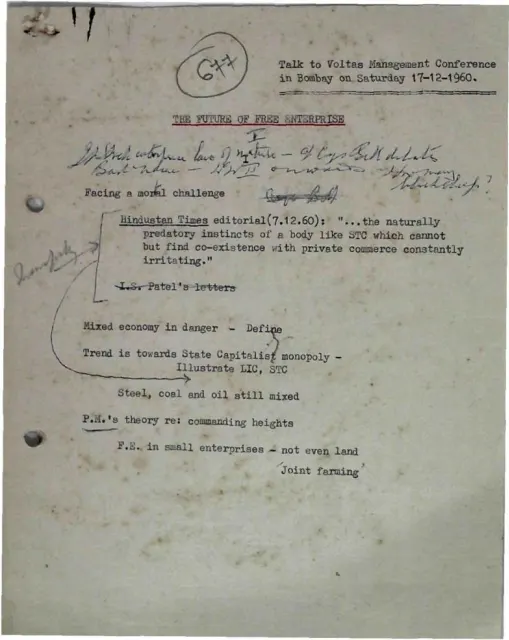 Primary workTHE FUTURE OF FREE ENTERPRISE IN INDIA
 ExcerptSTATE MONOPOLIES AND THE CITIZEN IN A DEMOCRACY
 ThePrintPrivate enterprise built India’s industries. Now it’s strangled by Gods in Delhi