
speech · parliamentary
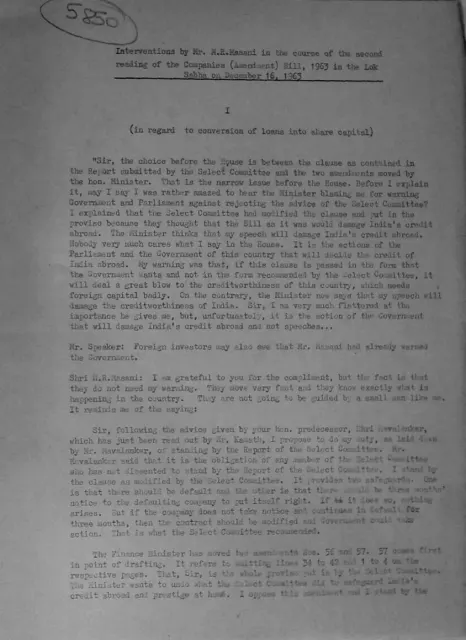
Interventions by Mr. K.R.Masani in the course of the second reading of the Companies (Amendment) Bill, 1963 in the Lok Sabha on December 16, 1963
1963
8 pages
Summary
This transcript records three interventions by Mr. K. R. Masani during the Lok Sabha’s second reading of the Companies (Amendment) Bill, 1963, on 16 December 1963. In the first intervention, Masani opposes Finance Minister amendments that would weaken the Select Committee’s provision concerning the conversion of loans into share capital. He argues that disregarding the committee’s recommendation would damage India’s creditworthiness abroad and emphasizes that foreign investors will judge the actions of Parliament and government rather than individual speeches.
The second intervention addresses the deprivation of individual trustees’ voting rights. Masani accepts a system in which voting rights may be withdrawn for misconduct or misuse, but insists on safeguards, judicial oversight, and a Public Trustee independent of the executive. In the third, he attacks proposed grounds for referring company directors and managers to a tribunal. While supporting action against fraud and breach of trust, he rejects vague standards such as failure to follow supposedly sound business principles or conduct thought likely to damage a business. He warns that bureaucratic judgment over commercial risk would undermine enterprise and concludes by criticizing the tension between the government’s stated support for individual initiative and the bill’s restrictive clauses.
Key points
- Masani defends the Select Committee’s provisions on converting government loans into share capital against Finance Minister amendments.
- He links legislative consistency and respect for committee recommendations to India’s international creditworthiness and ability to attract foreign capital.
- He supports restricting a trustee’s voting rights only through specific charges, equitable safeguards, and a right of appeal.
- He argues that a Public Trustee should be judicial or full-time and independent of the executive branch of government.
- He distinguishes legitimate tribunal action for fraud, misfeasance, breach of trust, or unlawful conduct from vague intervention in ordinary business decisions.
- He presents company directors and managers as those who have invested capital and therefore as better judges of commercial risk than politicians or officials.
- He characterizes clauses based on bureaucratic assessments of business management as an attempt to impose bureaucracy on private enterprise.
Metadata and summary are AI-extracted from the source PDF and reviewed for editorial accuracy. The original work is available via the Read PDF tab above (where present); paragraph-level citation inside the PDF is deferred to a future engagement.
Related across the archive
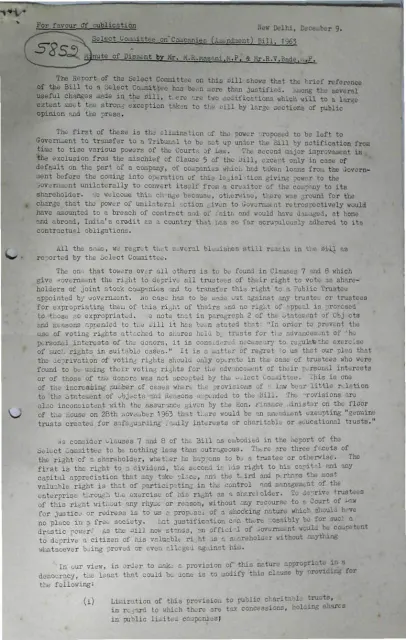 Primary workMinute of Dissent by Mr. M.R. Masani, M.P. & Mr. R.V. Bade, M.P.
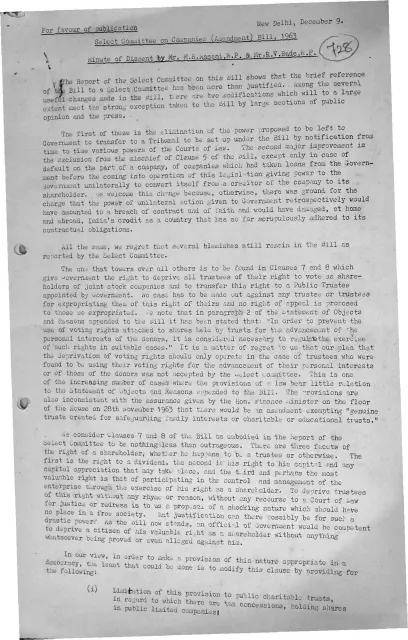 Primary workSelect Committee on Companies (Amendment) Bill, 1963
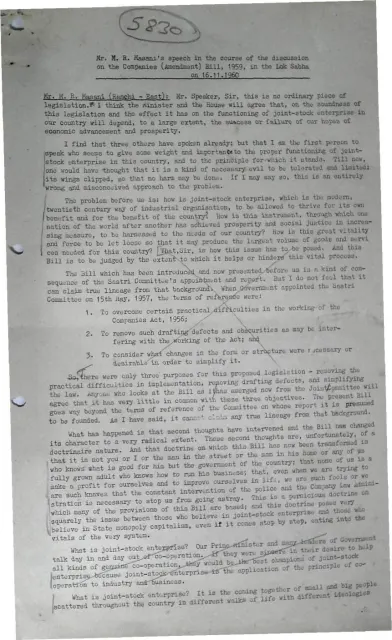 Primary workMr. M. R. Masani's speech in the course of the discussion on the Companies (Amendment) Bill, 1959, in the Lok Sabha on 16.11.1960
 ExcerptDemocracy in India
 ExcerptSTATE MONOPOLIES AND THE CITIZEN IN A DEMOCRACY